Posted in Goal

When to use Google Sheets? Important ways to organize your life

When to use Google Sheets you ask? Over the years, I have tried so many techniques and apps to mange my time, tasks, and productivity. There are some pretty great digital apps, but lately my fall back solution is to use Google Sheets. And I’m loving it!

Sometimes simpler truly is better. Some of the features I love about Google Sheets is that I can create checkboxes, color code different categories, easily copy and paste from one area to the other, and create links between sheets to further organize a goal or task. So let’s break it down into the ways I use Google Sheets to organize my life and keep me motivated.

when to use google sheets for Health and Fitness Goals

First, let’s talk about health and fitness. Right now I don’t have access to a scale, which honestly is probably a good thing. I am walking a ton in Norway where I call home at the moment. So before that, I tracked my weight every week in a Google Sheet.

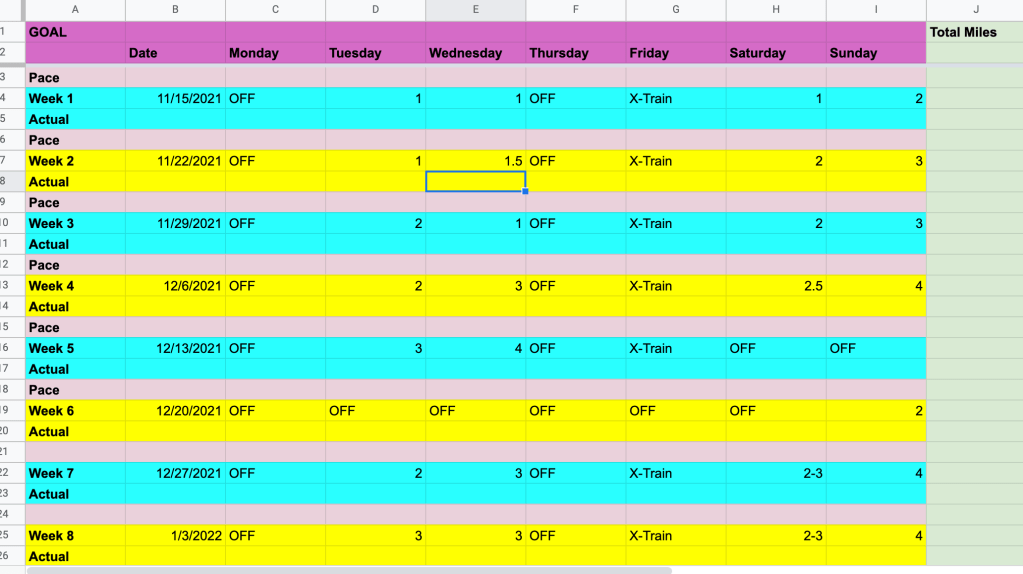
However, one of the most productive things I’ve done is create a training guide to complete a half marathon.

when to use google sheets

That method worked for me! At that time, I was already pretty in shape so I was able to start my first week with 2-3 miles.

Since it has been 5 years since I ran that race and I let running go, despite it being an excellent stress reliever, I have decided to do another one! I am planning to run the Bergen City Half Marathon at the end of April 2022.

So, of course, what did I do? I created a 20-week training plan with Google Sheets for myself! I will be on a European adventure trip for 8 days in December, so I just went ahead and blocked that week off so I don’t have to worry about being “disappointed” if I don’t meet my goals for that week. I will probably be walking a ton anyway. And since I am starting way more out of shape than last time, I’m giving myself a few slower weeks to ease back into running.
when to use google sheets

When to use google sheets for budgeting

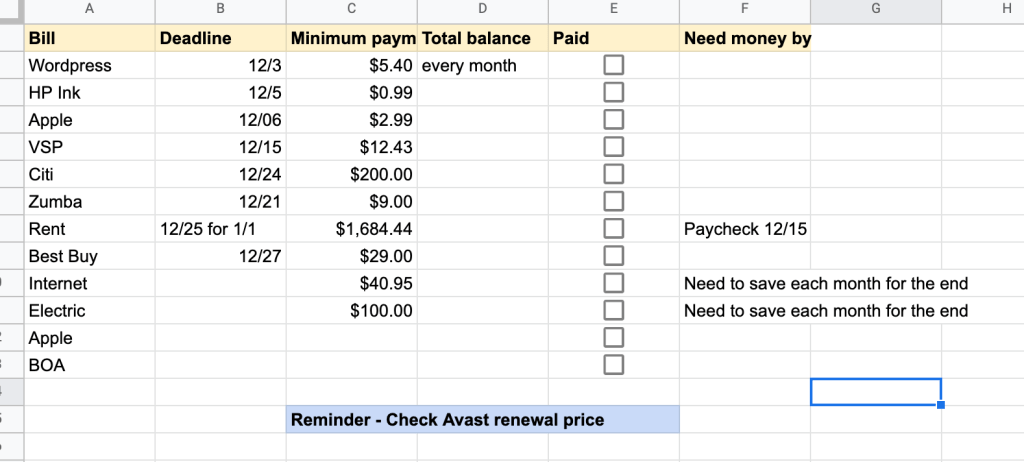
I do not have a fancy or detailed budgeting system. I mainly use Google Sheets just to make sure that all my bills are paid on time each month. It also helps remind me to have enough money in my account for automatic withdrawals.
when to use google sheets

I should probably call this a bill system and not a budget system because you can see that I don’t account for food or miscellaneous expenses. This is my checklist for December. Some of the amounts change depending on renewals and you see I also put reminders when I know annual subscriptions are coming up. You don’t see car insurance on my December bills list because I am only paying about $40 every 6 months while I am in Norway and my car is just sitting in the U.S.

I am a licensed Zumba instructor, but I just don’t have the time right now to continue classes. And most of the people that attended my virtual classes previously were in a different time zone. So, I am paying a monthly hold fee so I don’t have to redo the whole licensing process when I get back to the U.S.

when to use google sheets for Daily and Weekly Tasks

I have tried all sorts of methods of tracking daily to do lists. Now, I just simply type my tasks out in the day I would like to complete it during the week it needs to be done. I can work several weeks ahead so that reminders go in and I don’t forget about important things. Then, when the week has passed, I just hide the sheet so the current week is first. If I don’t get it done, I just cut and paste it into the next day. I go through my action items for the week every Sunday night.

when to use google sheets

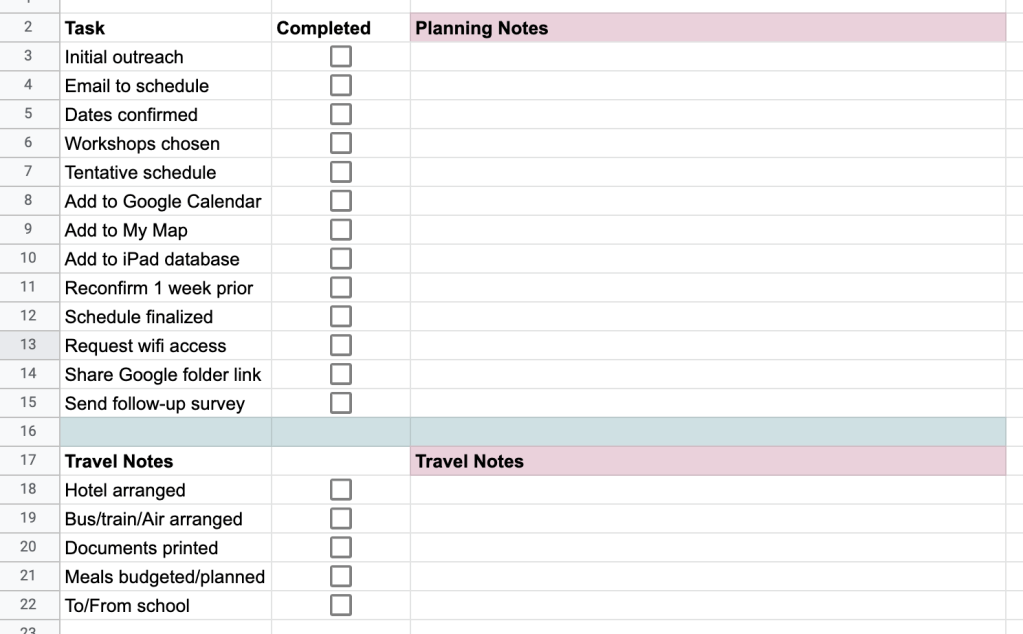
For my current job in Norway I have a lot of details to manage. I have to create a schedule for the year of places that I’m going to give workshops. Then, I have to make sure I do a bunch of things during that communication. So I created one giant Google Sheet that has the weeks of the school year listed. I put the main details in that sheet and then link to a checklist for each school visit. All the checklists are on individual tabs in a separate Google Sheet document.
when to use google sheets

when to use google sheets as a Habit Tracker

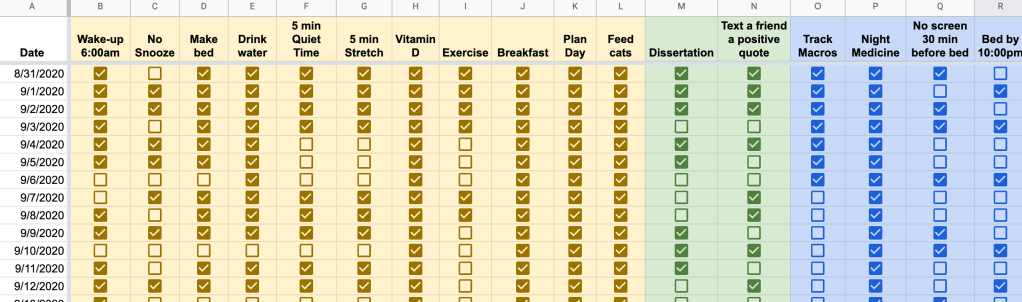
Another way I use Google Sheets to organize my life is a habit tracker. Again, I’ve tried different forms of this, and I even have a PDF habit tracker for free here on my site. Here is a screenshot of how I used it in the past. Obviously, I was still in the process of building the habits then. Now, I don’t have to think about all of them quite so much. I used this when I was trying to build a solid morning routine.
when to use google sheets

Final Thoughts for Today

There are many different ways you can use Google Sheets to organize your life. These are just some of the examples that I use to keep myself focused and organized. I’m sure if I went back through my whole Google Drive I would find even more examples. Share in the comments how you use Google Sheets for organization!


Posted in Goal, Manifestation

5 Things to Focus on in the New Year: Self Love

Self love – This is part 2 in a 5 part series. Well, part 1 focused on time management and part 2 is focusing on self-love. As I looked back through my blog posts for the year, I realized I talked about self-care and building confidence, but I’m not sure I touched on self love and acceptance. Perhaps it’s because it’s still an area of improvement in my life. Something that doesn’t quite feel like I fully made it there yet.

But isn’t the journey more important than the destination?

So what if I never get to 100% self love and acceptance? That would be amazing and maybe I will, but figuring it out is just as important. Because if I’m always focusing on how I’m going to feel when I fully love and accept every piece of myself, then I can’t focus on fully loving who I am in this particular moment.

I always want to improve and become a better version of myself. We should strive to improve and grow as individuals to better for ourselves and the people around us. Ironically, putting myself out here into the digital world is helping me reach a more accepting and loving view of myself. My confidence is growing and I am realizing more and more each day that there is only one me in this world.

Self Love Goals for the New Year

  1. Start each day by looking in the mirror and saying one thing I love about myself
  2. Continue to say and write affirmations on a daily basis
  3. Reduce automatic negative thought patterns
  4. If someone gives me a compliment, accept it and do NOT downplay it
  5. Continuing aligning physical health and mental health

This is not a linear process, but it is a process that needs to happen. I encourage you to embark on your own self love and acceptance journey!

Posted in Goal

4 Tips to Master the Power of Effective Scheduling

Effective scheduling is key. Some people say that I’m a planner. Others say I’m calendar-oriented. Really, I just like to make sure that my time, tasks, and priorities are all reflected in my schedule. When someone asks me to do something and I agree (also power in saying no), I immediately add it to my Google Calendar, which can be accessed on my phone, iPad, and laptop. No matter where I am I have access to it.

If it is a work or professional meeting, I copy the Zoom or webinar link from the email and paste it directly into the calendar event that I create so that I do not have to search for the email when it’s time to log in.

effective scheduling
Photo by RODNAE Productions on Pexels.com

Effective scheduling: Clarify your goals

It is important to know what you want to accomplish with your time. You cannot create an effective schedule if you don’t know what you are aiming for. I wrote a post on mini-goals here. Get specific on the main areas of your life and figure out the chunks of time that need to be spent on each.

Effective scheduling: Prioritize your tasks

When you sit down to work, or even at the beginning of every day, take a look at everything that needs to be accomplished. What is that one thing that can’t be put off? Do that first, in the morning if you can. For longer term projects, break it down into smaller deadlines and place those on your calendar. If you’re not sure how to prioritize, consider using a strategy like the Eisenhower Matrix.


Effective scheduling: Utilize a digital calendar like Google Calendar

Keep a calendar that can be accessed from all of your digital devices: laptop, phone, iPad, etc. That way, you always have access to what you need in the moment if someone asks to schedule something. Personally, because I work several part time jobs and manage my own schedule, I keep one Google Calendar for everything and color code by activity, including my personal commitments. For example, if a friend texts me and says, “hey, we should catch up on the phone Thursday around 8pm.” If I’m free, I actually confirm and add that to my calendar so I don’t forget to call or accidentally make plans to do something else because I forgot we were going to chat.

At work, I utilize my email kind of like a to-do list. I try to check my email at certain points throughout the day, but if something comes on that I need to take care of that day or later in the week, I also add it to my calendar and include the reference email.

Effective scheduling: Learn to Say “Let Me Get Back to You”

If you’re a kind-hearted person who wants to follow through with helping people or do a good job, you’ll be tempted to say yes to everyone and everything. That is not a realistic way to manage a schedule because you will quickly become overwhelmed. However, instead of saying no right away, give yourself some think time when someone asks you to do something or for another meeting or a favor. Evaluate if it fits with your goals and priorities or fits in any extra time you have available for leisure. If not, perhaps you may have to decline or ask the person to check in with you at a later date.

These are just some of the strategies that I use on a regular basis to maintain my schedule. Please leave a comment if you’d like to hear more about any of them!

Posted in Uncategorized

3 Helpful Strategies to Organize Your Email Inbox Today

Organize your email inbox: A little over three years ago I made the switch to a zero inbox and it was the best thing I ever did for my organizational skills. At that time I had had my personal Gmail account since about 2005 with thousands and thousands of emails. Instead of taking time putting everything into folders, I simply decided to archive it all and start from that day forward. Since I started a new job, I was able to keep my work email at zero inbox from day one.

Table of Contents

    Organize your email inbox: Here’s how I manage emails now to keep my inbox as close to zero as possible:

    1. Check email first thing each morning (after affirmations and to-do list) and before I close my computer from work for the day. By doing this, I can deal with any emails that came in before I started my workday for all the early birds who start before me, and then I can create a plan for everything left over at the end of the day.
    2. Check email at set times throughout the day. Now, I don’t always follow this rule perfectly because it depends on what I’m working on. If I need to focus on a project or task and I don’t want to be disturbed by emails, I close the tab and set my timer to check it once per hour or every 2 hours so as to still be responsive to the needs of coworkers, but not be interrupted by constant flows of incoming emails.
    3. I use the two-minute rule when dealing with emails as I go through them. This idea comes from the Getting Things Done method by David Allen. If it’s something I can respond to right away, I quickly send a reply and then file that email in a folder. If it doesn’t need a response, I file it right away. If it’s informational and a deadline is attached, but it’s not immediate, I use the snooze feature to send it back to me when it needs to be completed or responded to. If it is going to take a bit longer, I work on it during an email response period during the day.

    organize your email inbox
    Photo by Oleg Magni on Pexels.com

    Gmail tips

    So by the end of the day everything should either be snoozed, responded to, or filed in a folder. I rarely delete emails because I do frequently have to refer back to old emails for information and it’s very easy to find when they are in folders. I also use the search function in Gmail to find the emails that I need. For newsletters and subscriptions, I create filters that send the emails directly to folders so it doesn’t even have to come to my inbox. These are great ways to organize your email inbox.

    My personal favorite Gmail settings are to use the compact view with conversation view off. I like to see all my emails individually and conversation view confuses me a bit. Because I see all messages individually, I sometimes will only keep the most recent email in a thread and delete the rest because it’s not needed.

    And, to save me a little time, I have smart reply turned on so it auto-detects what I might want to say. It’s kind of scary how accurate it is. I also use Grammarly to check my spelling, tone, and grammar as I go.

    Organize your email inbox: Keeping my email organized and efficient has helped me to save time and communicate effectively!

    Posted in Goal, Manifestation

    What is the difference between dreams and visions- 3 Important distinctions?

    What is the difference between dreams and visions you ask? Dreams and visions are often confused as the same thing, but they are in fact very different. Knowing the difference between a dream and a vision is important for your personal development as well as your business. Dreams will never come true until they become a vision. Luckily, there are ways on how to turn dreams into visions. In this article, I will show you the differences between dreams and visions including the elements that differentiate them.

    A dream is a strong fantasy whereas vision gives a clear direction

    A dream is a strong fantasy, which may or may not come true. A vision is a clear direction for the future and it is backed by action.

    A dream is a strong fantasy: You can always imagine something wonderful happening to you. For example, if you had a bad day at work, you might imagine that your boss comes to you and says, “You have done an excellent job and we are so happy with your performance. We want to give you a promotion!” Unfortunately, it doesn’t always happen that way. It is just imagination and there has been no real effort on your part to make it happen in reality.

    Vision gives a clear direction: Your vision for your life should be something bigger than yourself. It should also be something that gives meaning to your life as well as purpose – something that will help others as well as yourself.

    Again, what is the difference between dreams and visions?

    Dreams are based on wishes, desires, and emotions whereas visions are based on reality and specific goals

    The main difference between dreams and visions is that dreams are based on wishes, desires, and emotions whereas visions are based on reality and specific goals.

    Dreams are generally what we would like to happen, while visions are what we believe will happen.

    When you dream, you let your mind wander through all the things that might happen if everything went right. You think about how great it would be if you had a new job or home, or even just went on vacation.

    A dream can be a wishful thought or something that’s as simple as “I wish I could go to the Bahamas.” It’s an idea that seems impossible, but it’s still something that you hope for deep inside.

    What is the difference between dreams and visions?

    A vision is something that you have clear ideas about and specific steps toward achieving it. It involves setting goals and planning out how to achieve them. For example, if you had a vision for going to the Bahamas next year, you’d probably make plans for saving money throughout the year so that you could take time off work without having financial worries holding you back from going on vacation.

    what is the difference between dreams and visions
    Photo by Ylanite Koppens on Pexels.com

    Dreamers spend their entire life trying to achieve their dreams whereas people with a vision don’t spend time achieving their vision because they are already living it

    A dreamer is someone who dreams of a better life, but doesn’t do anything to make it happen. A dreamer is someone who has a vision of what they want to be and where they want to go, but they don’t have the will or drive to make it happen.

    A dreamer spends their entire life trying to achieve their dreams whereas people with a vision don’t spend time achieving their vision because they are already living it.

    People with a vision understand that you must take action in order for your dreams to become reality. They don’t wait for things to happen, they make things happen. They know what they want in life and they’re willing to work hard until they get it!

    So, what is the difference between dreams and visions?

    The difference between dreams and visions is action. When you dream, you are looking inward; when you have a vision, you are expressing it outward. Some people only see the world around them through their supposed limitations, but others look for opportunities to reach their full potential. To accomplish anything you need to take action.

    Posted in Goal, Manifestation

    Setting Realistic Goals Is The Key To Getting Important Things Done

    Setting realistic goals: When most people think about goals, they think about vision boards and long-term objectives. It’s not a bad idea to have those things, but you also want to be realistic and set goals which are measurable. And often times, this means breaking it down into smaller goals and shorter timelines.

    Focus on how you can connect with goals that are meaningful to you

    The best way to set goals is to focus on the process of reaching them, not just the end result.

    Most people set goals like this: “I want to lose weight.” But that’s a goal that may only ever be partially achieved. You’ll lose some weight, but it may not be all you want it to be. And once you’re at your desired weight, what will you do then?

    Instead, it’s better to focus on how you can connect with your goal. For example, here are two different ways of thinking about losing weight:

    I want to feel more energetic and healthy.” This is a goal that can be achieved by eating well and exercising regularly — no matter what size or shape you are. It’s something that will sustain itself over time because it’s not dependent on a certain number on the scale or an outfit fitting better in the closet (which are both external factors).

    In order to go about setting realistic goals that matter and are achievable, it’s important to focus on what you can realistically achieve in the next three to six months. Here are some examples:

    • Ask for a raise at work
    • Improve your health by exercising more and eating better
    • Travel somewhere new with your friends and family

    End with a plan for how you’ll get from where you are now to where you want to be

    The process of goal-setting looks easy, but it’s not always easy to know how to develop a plan for setting realistic goals and achieving them. Here are some tips for developing your plan:

    • Break down each step into smaller tasks. For example, if one of your goals is to run a marathon by the end of 2022, what steps do you need to take? You might break this down into weekly training sessions and then monthly long runs so that there are milestones along the way.
    • Figure out how much time you need for each task on the path toward achieving your goal. If it takes two hours per week (and let’s say we’re talking about studying) then twelve weeks before test day equals twenty-four hours total—that’s enough time!

      It may seem like a lot at first glance but once you’ve broken down everything else into smaller chunks and scheduled them out throughout the year (or even just over three months), suddenly committing twenty-four hours isn’t so daunting anymore! In fact it may actually be easier than breaking open a new book now would feel like because those twenty four hours are already accounted for in advance thanks to our earlier planning efforts.
    setting realistic goals
    Photo by RUN 4 FFWPU on Pexels.com

    Remember your goals and find ways to achieve them

    Now that you know how to set goals, let’s take a look at some of the many ways that goal setting can help you achieve your dreams.

    • It helps us to remember our goals and find ways to achieve them.
    • It helps us visualize our goals.
    • It helps us set priorities for achieving each goal.
    • It measures our progress toward achieving each goal using tangible measurements like numbers or percentages instead of just feelings alone!

    Look at your situation honestly, not naively or selectively

    Every year I set goals for myself. I am pretty good at it too, but what I learned is that if you don’t set the right goals, or if you set a goal that’s not in line with your values and the things that mean most to you in life, then there is no real motivation to do anything about them.

    I tend to make lists of things I would like to achieve during the year and then break them down into smaller steps so they are more manageable. And then when I look at these steps, they should all be aligned with my values and what matters most to me.

    For example, if one of my main values is family time and spending quality time together as a family unit, then any goal that supports this would be considered a higher priority than something else (like booking flights for holidays).

    The same goes for other areas of life such as health or finances – if there’s something on your list that doesn’t support your health or financial goals then it’s probably not worth doing anyway!

    setting realistic goals
    Photo by picjumbo.com on Pexels.com

    Setting realistic goals allows you to consider the realities of your life while still dreaming big

    For example, going back to running a marathon, it’s realistic to also set goals around training and diet. You may decide to run five miles every day for three months, or eat healthier foods at every meal.

    You can also be realistic about the amount of time it will take for your goal to be realized. If you plan on running a marathon in three months, it’s more realistic to set intermediate goals along the way—for example, running two miles per day for one week—and then celebrate even small successes along the way!

    Setting realistic goals allows you to see how far away your dream feels when compared with where you are now and how much work needs to be done before it becomes reality.

    Setting realistic goals for yourself

    At the end of the day, regardless of whether your goal is big or small, it’s important to remain realistic in your expectations and to ensure that you are meeting that goal. Reaching your ultimate goal can be a tough challenge, which is why you should always set smaller goals along the way. Smaller goals may not always seem as impressive as some larger goals, but they help you with achieving the big-picture vision.

    Posted in Goal, productivity

    6 Ways To Increase Productivity In Your Employees and Reduce Stress

    How to increase productivity in your employees? This is an important question that requires a level of empathy and understanding. Business leaders around the world are constantly looking for ways to increase the productivity of their employees.

    Whether it be by implementing new strategies, systems, or working conditions, improving the productivity of your team is an important priority, even during these tough economic times. So how exactly can that be accomplished while making sure to respect the human aspect of your employee?

    Make sure that tasks are clearly assigned

    Stress comes from uncertainty and confusion over what needs to be done and how it should be done. If you want to reduce the amount of stress in your workplace and increase productivity in your employees, make sure that each employee understands what his or her responsibilities are. When you give employees clear instructions and expectations, they know what they need to do and how they should go about doing it. This will help eliminate the kind of ambiguity that causes stress in the first place.

    Create a positive work environment

    Make sure that the workplace is set up in such a way that employees have what they need to be successful. This includes providing enough resources (time, money, equipment), making sure that the space is clean and welcoming, and keeping distractions at bay. You may also want to consider setting up a break room or other type of area where employees can go when they need some time away from their desks or computers. All of these work environmental factors contribute to the ability to increase productivity in your employees.

    Set time aside for communication

    Communication is key when running any business so make sure that you have regular meetings with each of your team members (at least once every week). These meetings should not be used only for checking up on progress but also for talking about personal issues as well as work-related problems. This will ensure that everyone feels comfortable talking about what’s going on instead of keeping it all bottled up inside until they explode later on!

    Increase flexibility within the workplace

    The nature of work has changed dramatically over the past decade or so. We no longer have 9-to-5 jobs that don’t require us to be online 24/7. We’re expected to respond and answer emails at all hours of the day, which only increases stress levels for everyone involved.

    One easy way to help alleviate this problem is by giving your employees more flexibility with their schedules. Let them choose when they want to come into work or take extended breaks throughout their day instead of having set office hours where everyone has to be there at 8:00 AM sharp every morning (and then staying until 6:00 PM).

    Provide opportunities for growth at every level – from entry-level positions up to management roles – so each employee has the opportunity to advance his or her career within your company as well as move up into higher positions within other organizations if they choose to do so in the future.

    increase productivity in employees
    Photo by Max Vakhtbovych on Pexels.com

    Increase Productivity in Your Employees by Encouraging office wellness programs

    You can start with something as simple as offering free fruit or snacks in the office kitchen, or even just having some games available for the staff to play during breaks. If your company has a gym or fitness center on site, consider offering discounted memberships to your employees. Healthier employees tend to be happier and more productive, so this can pay off in both ways!

    Organize team outings and events outside the office. There are many fun things you can do together as a team outside of work hours — going bowling or playing miniature golf are great examples! Even if it’s just once a month, taking some time away from work will help relieve stress and increase overall happiness at work.

    Prioritize employee health and wellbeing

    Make sure your team knows what’s expected of them, and give them the tools they need to get the job done. For example, if you want to increase productivity in your employees, you may want to consider giving them more freedom in their personal lives so that they don’t feel overworked or stressed out at home.

    Encourage self-care practices such as taking breaks or going for walks during the day rather than working continuously from 9am until 5pm. This will help them focus on their work more easily because they’re able to recharge their batteries when needed.

    Takeaway: To increase productivity in your employees, you need to make them happy and feel like they are valued.

    Posted in Goal

    Starting on YouTube? 5 Helpful Tips to Get you Going

    Starting on YouTube is hard work. You might see the successful entrepreneurs earning money and doing well, but that didn’t happen overnight. It takes time, strategy, mindset, and determination for your YouTube channel to do well. And most of all, consistency. I know this because I am still on my beginner’s journey to utilizing the full potential of YouTube.

    So you’re looking to start a YouTube channel and you’re really excited about it! With all the tools available for making content for your channel, the sky is literally the limit. One thing that holds many people back from starting their own channel though is fear. Fear of what? Maybe it’s fear of rejection, fear of not being able to create the content, fear of not getting likes or views, fear of being a bad YouTuber…whatever it may be…I have five tips to help you get over those fears!

    Don’t wait for ‘perfect’

    The most important thing to remember is that your first video doesn’t need to be perfect. It’s easy to get caught up in making sure your lighting is just right, that you have the perfect backdrop and that you’re wearing the perfect outfit for your first video. But don’t let that hold you back from getting started — put something out there! Your first video doesn’t need to be perfect; it just needs to be good enough. People are now filming everything in real-time with YouTube shorts, live, Instagram, and Tik Tok.

    There’s no such thing as being ready when you’re starting on YouTube. There are always improvements that can be made, but the only way to improve is by starting small and moving forward with what we’ve got. If you’re waiting for your channel or videos to be perfect before launching them out into the world, it might never happen. Take action now — even if it means just recording yourself talking into a phone while walking down the street — and move forward every time you’re ready with something new.

    Be Yourself

    Be Yourself and be relatable. Don’t sacrifice who you are as a person, but also be aware of what your audience wants. You should have fun while you’re creating content, but always keep in mind that they are watching because they want to see an authentic version of who you are.

    Choose a niche or multiple niches. If you have more than one interest, choose one area that you want to focus on first and build upon it over time. If you decide later on that there’s another niche that interests you more than the first, go for it!

    Create great content that stands out from the rest of the crowd. Don’t try to copy other people’s videos (and don’t let anyone else copy yours). Create something unique and share it with people who will appreciate it!

    Don’t try too hard or take yourself too seriously — just be yourself!

    starting on youtube
    Photo by cottonbro on Pexels.com

    Be Consistent

    It’s important to keep posting on a regular schedule. This will help your audience know what to expect and connect more with you. When you’re starting on YouTube and consistent with your videos, people will start looking forward to them, and they’ll share their excitement with others who might be interested in what you’re doing.

    When starting on YouTube, it’s important to respond to comments & questions in a timely manner. People love interacting with other people online, so take advantage of this by responding quickly when someone comments on one of your videos or asks a question! You’ll start building relationships with your viewers which will lead to more subscribers over time if they feel like they can relate with you and get answers from

    Learn from Others

    There are so many other YouTubers out there willing to share what they’ve learned along the way. Take the advice and use what works for you. Don’t be afraid to ask questions either! In fact, this is one of the best ways to learn from others — by asking questions!

    In fact, some of these people may even be willing to work with you if they like what they see!

    Take advantage of YouTube Analytics

    One of the great things about YouTube is that it provides plenty of analytics that help you understand what’s working and what isn’t. Check out your watch time and view rate — these can help you determine what type of content people like most and what they don’t like at all. You can also see where viewers drop off during a video, which can help you identify areas where improvements need to be made.

    And if you want to dive a bit deeper into SEO, then consider using a program like Tube Buddy to help even more:

    https://www.tubebuddy.com/Tracydeetips (affiliate link)

    It’s true—starting on YouTube may be a little nerve-wracking. There are so many things to keep in mind, and it can be hard to stay focused on everything you need to do as an aspiring YouTuber. But if you’re determined to get going on YouTube, don’t fret! As the saying goes, it gets easier with practice. Follow these tips, stay patient, and you’ll be making videos in no time.

    Posted in Goal

    How to Stop Procrastination: 5 Easy Ways To Stop Procrastinating And Get More Done Right Away

    How to stop procrastination. What an important question. Have you ever worked on something then suddenly lose your motivation and start procrastinating? If you have, I’m sure you’ve had a moment where you just want to give up. As long as we’re alive, procrastination is inevitable.

    According to research by the University of Sheffield, around 80% of us will procrastinate at some point. And while some people are better at managing their time than others, it seems like we all struggle with procrastination at some point or another.

    When we get home from school or work, many of us aren’t motivated enough to do anything productive. We watch TV or spend time on social media instead of making real progress toward our goals. This article will show you five steps that have helped me stop procrastinating and get more done on a daily basis.

    How to stop procrastination: First, find out why you are procrastinating, and then go after that.

    First, find out why you are procrastinating, and then go after that. If it’s because you’re tired or just don’t feel like doing what needs to be done, make sure that you get enough sleep and eat properly so that your body is well-rested and nourished.

    If you find yourself putting off work because your mind is somewhere else, try focusing on the task at hand by visualizing how good it will feel when it’s finished or imagining what others will think of you when they see how well you did on your project.

    If you have anxiety about completing something, ask yourself if this fear is rational or not. Do I really need to do this today? Or do I just want to get out of doing something? Is there another way around whatever is causing the anxiety? If so, try using it instead of avoiding the task altogether!

    How to stop procrastination: Determine Your Most Productive Time of Day

    You may think you’re a night owl or a morning person, but chances are your productivity isn’t affected by when you wake up — it’s affected by when you start working on important tasks.

    Instead of being held to your biological clock, determine what time of day works best for you, and then make sure that’s when you get started on important tasks (or at least try).

    This way, if you’re feeling tired at 11 pm, there’s no harm in pushing back an important task until tomorrow morning instead of trying to get it done tonight!

    I recently saw a video where someone recommended that you prioritize yourself in the morning. Meaning, try to reach your personal goals before going to the work you need to pay the bills.

    how to stop procrastination
    Photo by Suzy Hazelwood on Pexels.com

    How to stop procrastination: Create a To-Do List – Check!

    The first step in getting more done is creating a to-do list. This might seem like an obvious tip, but so many people don’t do this because they think they don’t need one or they’ve heard bad things about them (e.g., “I’m just not good at making lists”). But the truth is that making lists is one of the easiest ways to get things done! They help us prioritize our tasks so we can focus on what’s most important, they help us feel more organized, and they make us feel less overwhelmed by giving us a sense of control over our day-to-day lives.

    How to stop procrastination: Set Up Small Rewards for Reaching Goals

    The easiest way to stop procrastinating is by setting small rewards for reaching your goals. You don’t have to wait until you reach your final goal before rewarding yourself (although that certainly helps). Instead, set up small rewards along the way that are achievable and easy enough that they won’t take up too much time or energy on your part.

    For example, if you want to write an ebook and make some money from it, don’t set aside time on Wednesday night at 8 pm for writing your book. Instead, set aside 30 minutes after lunch each day for writing 500 words or so. Once you do this consistently for a week or two (without missing any days), then reward yourself with something that makes you happy.

    How to stop procrastination: Make It Quick and Dirty at First

    And last but not least, make it quick and check that box to give you a boost to keep going. If you’re feeling overwhelmed by your task list, start with the easiest tasks first. That way, when you check them off your list, you’ll feel accomplished and motivated to tackle the rest of it.

    Hey, sometimes I write something so easy on my list just so I can cross it off. And you know what? It works!