Posted in Finance, Work From Home

Ways to Make Money Working From Home

Well, now that I’ve had the privilege of working full time from home for over a year, the one thing I can say I have enjoyed the most is autonomy over my schedule. I did have that before, even when going into the office or teaching at my school to some extent, but more time was available to me without the commuting back and forth to different places.

Now, I’m in a bit of a 3 month limbo here between my current part-time job and my next full-time venture. I’ve utilized some of these freelancing sites before off and on to try to make a bit extra, but I’m especially interested in earning a stable income over the next couple of months from these opportunities.

I will share the two main sources of part-time WFH income I’ve used and then some of my aspirations to grow over the next couple of months.

  1. Rev.com – This is a transcription company that has clients from all over the world submit interviews and meetings to be transcribed. You have to apply by completing a transcription test. There is a learning curve by getting used to their system and platform, but once you figure it out, it gets much easier. You start out at the lowest level and then if your stats are high enough after 800 minutes, you move up to the highest tier. This is better because you have access to higher paying jobs and clearer audio files. Some of the initial files can be tough in the lower category, but if you stick with it, you’ll find it’s actually pretty fun. The pay is per minute and varies by each file, and is paid out weekly.
  2. Upwork or Fiverr – So far, I’ve only completed jobs on Upwork for editing and formatting. Because of my background in education and research, this category works well for me. Upwork is what I started with about 3 years ago, but now I’m interested in setting up a profile on Fiverr as well. It’s pretty simple to set up a profile, but be prepared to answer questions when you’re bidding on jobs to show your level of experience or expertise.

New WFH goals:

  1. Etsy – I started a shop a few months ago, but haven’t had a lot of time to continue adding products. I’ve watched a lot of YouTube video tutorials on making and selling digital products. My shop is called Tracy Dee Designs and currently I have 11 digital productivity products and 1 physical product. I am learning how to create more designs on my iPad using the Procreate app so I definitely hope to keep adding to my inventory and create some more income from that.
  2. E-books – I have a lot of training in education and since writing is still in my routine, I was thinking about creating some e-books to sell. I made a 30 day time management journal that I posted in my Etsy shop. Another avenue is to use Amazon Kindle Direct Publishing and make sure to format designs in Canva to match their requirements.

If you google making money working from home, you’ll get tons of articles and websites directing you to opportunities. I know I only listed 4 different avenues here, but I prefer to start with some small, proven websites and then build from there if I still need more. For example, if you stay consistent with transcribing on Rev.com a little each day, you could make a pretty decent monthly side hustle.

The thing that is appealing to me about the Etsy store and the e-books is that it really turns into passive income over time. It takes effort to create everything up front, but with digital products, you only need to do it one time. I’m also taking time to market on Pinterest and of course, here on the blog and on my YouTube channel. All of that is part of committing to a goal that may take a little bit of time to get off the ground.

Whatever you choose to do, make sure to verify it is legitimate and decide if it is worth the time investment to get started.

Posted in Goal

Creating a Helpful Seasonal Action Plan and Calendar

I think everyone needs an action plan of sorts. But, it won’t look the same for everyone.

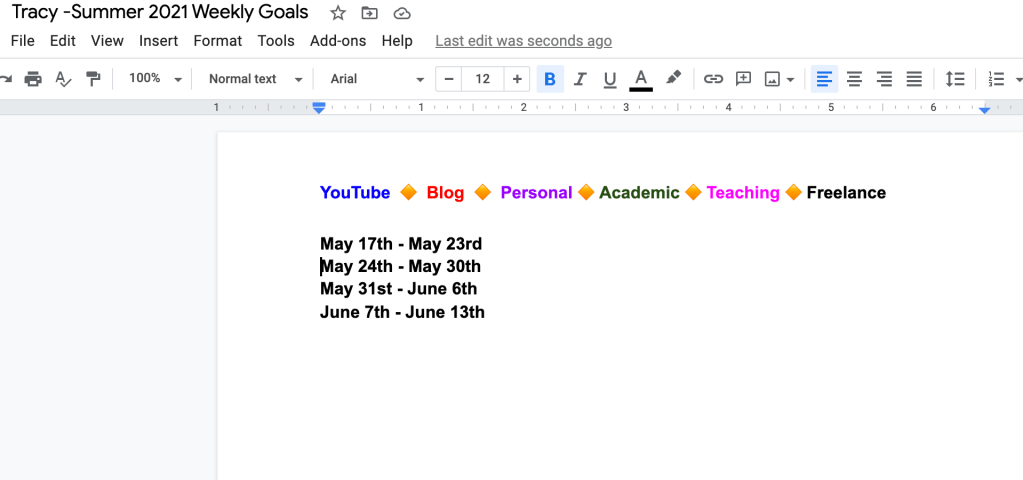
Being in school for so long has taught me to create a plan for each semester. So how exactly do I go about this? Basically, every spring, summer, and fall, I look at all of my deadlines and map it out onto a Google Doc with the weekly dates for the 12-16 weeks. I color code the main categories and have a key in the header and footer of each page. I learned this method from the National Center for Faculty Development and Diversity.

Even though I’m now graduating, I am going to continue this method of planning because it truly helps me to get a big picture overview of my goals. I can then match my big goals to subtasks by making weekly progress toward completion.

Here is a snapshot of a week from last summer:

action plan

Each week would have a similar format that I copy and pasted for the whole summer. In May, I go through and add in important deadlines and repeating tasks. For example, my teaching timesheet is due every two weeks. Now, I also include these repeating tasks in my Google Calendar. Some may find this process repetitive, but it actually helps me remember things by keeping it in multiple places.

So, because it’s time to think about Summer 2021, I am in the process of creating my next 12 weeks or so goals. I’m still working out what I’d like my categories to be, but I’ve started to put in my dates and then will create my outline and fill in goals. The first pass through is all the big items, and then I re-evaluate every Sunday and prioritize my week, filling in additional items as needed.

Summer 2021 action plan

action plan

FREE Google Doc Summer 2021 Planning template!!

Here is a YouTube video showing how I go through these steps for the summer!

Posted in Goal, Personal Skills, Time Management

Summer Goal Planning: Creating a Seasonal Action Plan and Calendar

Being in school for so long has taught me to create a plan for each semester. So how exactly do I go about this? Basically, every spring, summer, and fall, I look at all of my deadlines and map it out onto a Google Doc with the weekly dates for the 12-16 weeks. I color code the main categories and have a key in the header and footer of each page. I learned this method from the National Center for Faculty Development and Diversity.

Even though I’m now graduating, I am going to continue this method of planning because it truly helps me to get a big picture overview of my goals. I can then match my big goals to subtasks by making weekly progress toward completion.

Here is a snapshot of a week from last summer (with some items removed):

Each week would have a similar format that I copy and pasted for the whole summer. In May, I go through and add in important deadlines and repeating tasks. For example, my teaching timesheet is due every two weeks. Now, I also include these repeating tasks in my Google Calendar. Some may find this process repetitive, but it actually helps me remember things by keeping it in multiple places.

So, because it’s time to think about Summer 2021, I am in the process of creating my next 12 weeks or so goals. I’m still working out what I’d like my categories to be, but I’ve started to put in my dates and then will create my outline and fill in goals. The first pass through is all the big items, and then I re-evaluate every Sunday and prioritize my week, filling in additional items as needed.

FREE Google Doc Summer 2021 Planning template!!

Here is a YouTube video showing how I go through these steps for the summer!

Posted in Goal, Manifestation

It’s Okay to Change and Become a Better Version of Yourself: 5 Helpful Tips

Really, becoming a better version of yourself is possible and totally a personal journey.

Sometimes I get stuck in this mindset of how people see me. Do they see me as the rebellious child, the dutiful teenager, the naive twenty-something, or who I actually am today? And honestly, I’m still figuring out who I am in a lot of ways. This year, especially, has been an opportunity to reflect and evaluate.

Over the last 5-10 years, I’ve taken time to work on my anxiety, leaving me to feel like a failure at times and at peace other times. However, it’s necessary to do the work on yourself before you can give to others. I used to think that was selfish, but now I’ve come to learn that I have to step back when needed. This is particularly true for overachievers like myself who just want to dive in and do the most.

But, I also have to give myself the same grace I wish to offer others, in learning and becoming a more critically thoughtful, kind, goal-oriented person.

I recently graduated with a terminal degree and this was my first weekend in 5 years that I didn’t have editing or work to do on a specific paper or assignment for school. Do I have other projects that I can work on? Yes, I do. But it’s not so pressing that I have to give up my Saturday or Sunday to complete them. With a more open schedule in the week ahead, these are things I can work on starting Monday morning for a more traditional work schedule.

become a better version of yourself
Photo by Jill Wellington on Pexels.com

So in light of this period of reflection, I thought I would share some of the resources I’ve used to continue my personal and professional growth.

Become a better version of yourself:

  1. Project Implicit – One of the areas I’ve been working on is becoming more actively antiracist and aware of my own personal implicit biases. This website from Harvard allows you to take a series of implicit bias tests to see where you are on a number of important issues. It’s a starting place to then seek other resources to continue to learn and grow, such as “How to Be an Antiracist”, by Dr. Ibram X. Kendi.
  2. Inspirational books – Although I haven’t had a ton of time to read for enjoyment, I plan to change that in the near future and dive in to material that inspires me to reach for my goals and aspirations. Two of the books I’ve really enjoyed these last couple of months are “Hello” Fears by Michelle Poler and “Year of Yes” by Shonda Rhimes. Both taught me to embrace new opportunities and not let fear hold me back. For example, even putting this blog and my YouTube channel out there is scary for me.
  3. Free online courses – There are sooooooo many ways to get free knowledge. I paid a lot of money for my degrees, but you don’t necessarily need to pay for information now. You can go to YouTube or websites with free courses. Some are even worth paying for a membership if you intend to continue your professional learning. I wrote another blog post here about some of the websites that I utilize to take free courses on topics of interest. These are helpful tools on the journey to become a better version of yourself.
  4. Therapy/counseling – I’ve said it before and I’ll say it again. I think everyone could benefit from talking to someone outside their day to day interactions. It’s helpful to process information, get strategies to change thought patterns, or deal with trauma. If you don’t know where to start, you can visit the CDC resources or National Alliance on Mental Illness. The process of counseling has helped me become more self-aware and grow my confidence.
  5. Affirmations – Along with counseling, the idea of positive affirmations is helping me to grow into the person I wish to become. I try to start my day with affirmations. Additionally, I have all of my annual goals posted next to my mirror on index cards by category. Each day, I see the goals I have for myself and I repeat statements that affirm my capability of achieving these goals for my future.

The final takeaway is that it’s never too late to change your thoughts, learn more, and become the version of yourself you wish to be. Don’t let fear or lack of time hold you back. Commit to 5 minutes each day to work on something for your personal self-improvement. Then, gradually increase that time as you are able to do so. I believe in you!! You can become a better version of yourself!

Posted in Goal, Manifestation, Personal Skills, Time Management

It’s Okay to Change and Become a Better Version of Yourself

Sometimes I get stuck in this mindset of how people see me. Do they see me as the rebellious child, the dutiful teenager, the naive twenty-something, or who I actually am today? And honestly, I’m still figuring out who I am in a lot of ways. This year, especially, has been an opportunity to reflect and evaluate.

Over the last 5-10 years, I’ve taken time to work on my anxiety, leaving me to feel like a failure at times and at peace other times. However, it’s necessary to do the work on yourself before you can give to others. I used to think that was selfish, but now I’ve come to learn that I have to step back when needed. This is particularly true for overachievers like myself who just want to dive in and do the most. But, I also have to give myself the same grace I wish to offer others, in learning and becoming a more critically thoughtful, kind, goal-oriented person.

I just recently graduated with a terminal degree and this was my first weekend in 5 years that I didn’t have editing or work to do on a specific paper or assignment for school. Do I have other projects that I can work on? Yes, I do. But it’s not so pressing that I have to give up my Saturday or Sunday to complete them. With a more open schedule in the week ahead, these are things I can work on starting Monday morning for a more traditional work schedule.

So in light of this period of reflection, I thought I would share some of the resources I’ve used to continue my personal and professional growth.

  1. Project Implicit – One of the areas I’ve been working on is becoming more actively antiracist and aware of my own personal implicit biases. This website from Harvard allows you to take a series of implicit bias tests to see where you are on a number of important issues. It’s a starting place to then seek other resources to continue to learn and grow, such as “How to Be an Antiracist”, by Dr. Ibram X. Kendi.
  2. Inspirational books – Although I haven’t had a ton of time to read for enjoyment, I plan to change that in the near future and dive in to material that inspires me to reach for my goals and aspirations. Two of the books I’ve really enjoyed these last couple of months are “Hello” Fears by Michelle Poler and “Year of Yes” by Shonda Rhimes. Both taught me to embrace new opportunities and not let fear hold me back. For example, even putting this blog and my YouTube channel out there is scary for me.
  3. Free online courses – There are sooooooo many ways to get free knowledge. I paid a lot of money for my degrees, but you don’t necessarily need to pay for information now. You can go to YouTube or websites with free courses. Some are even worth paying for a membership if you intend to continue your professional learning. I wrote another blog post here about some of the websites that I utilize to take free courses on topics of interest.
  4. Therapy/counseling – I’ve said it before and I’ll say it again. I think everyone could benefit from talking to someone outside their day to day interactions. It’s helpful to process information, get strategies to change thought patterns, or deal with trauma. If you don’t know where to start, you can visit the CDC resources or National Alliance on Mental Illness. The process of counseling has helped me become more self-aware and grow my confidence.
  5. Affirmations – Along with counseling, the idea of positive affirmations is helping me to grow into the person I wish to become. I try to start my day with affirmations. Additionally, I have all of my 2021 goals posted next to my mirror on index cards by category. Each day, I see the goals I have for myself and I repeat statements that affirm my capability of achieving these goals for my future.

The final takeaway is that it’s never too late to change your thoughts, learn more, and become the version of yourself you wish to be. Don’t let fear or lack of time hold you back. Commit to 5 minutes each day to work on something for your personal self-improvement. Then, gradually increase that time as you are able to do so. I believe in you!!

Posted in Personal Skills, Time Management, Work From Home

Using Gmail Efficiently: 6 Tips for Maximizing Your Inbox

I have been using Gmail for almost 20 years now. WOW!

I try to keep my email inbox at zero or as close to zero as possible at all times. During the day, the emails that are still there serve as my to-do list of sorts. I work through at certain times throughout the day and make a plan to address it on the spot. I also do not like to have email on my phone.

I find that I get distracted by the numbers and notifications and then I’ll read it and have to go back through it on my computer later anyway.

I have several accounts for different purposes. Although many people prefer to sync all of their email accounts, I actually like keeping them separate. It helps me compartmentalize the different tasks I have to do whether it be for school, personal, teaching, or entrepreneurial endeavors. And by having a separate teaching email account, I never miss a student question or concern because it doesn’t get lost in the many other emails I get on a daily basis.


Here are my top 6 tips for using Gmail efficiently

1. Compact View with Conversation Threading Off

I prefer the compact view the best in my inbox screen. I know a lot of people prefer to use the conversation view to group emails together, but I tend to get confused in threads and have to go back to figure out what was said.

By using the compact view, I do not miss any comments on any emails that are sent because each one shows up separately in my inbox. The compact view is nice because you can see more emails at a glance since the space is reduced between each one.

using Gmail

2. Smart Compose On

In the general settings, I use smart compose, grammar, spelling, and autocorrect. In fact, it’s kind of scary how accurate the smart compose is. It allows me to respond to emails faster because it predicts what I might say when I start a sentence. If I agree with the response, then I just click enter and keep typing the next portion of my email. I’ll all about ways to save myself time, but still write a quality and professional email response to someone.

3. Using Folders

Using Gmail, I go through my emails several times per day. Once it is filed or completed, it goes immediately into a folder. In my personal email, I have folders for advisory boards I serve on, billing information, doctor information, organizations I’m involved with, and much more.

Pretty much any activity has its own folder and that’s where the email lives after it has been addressed. It makes it much easier for me to find things later and know that I didn’t delete anything.

4. Setting up Filters

This setting is helpful if you get frequent emails from a specific person or organization. You can create a label and a filter for that person. It can be color coded and make it easier to stand out in your email inbox. Once you receive an email that you may want to filter, you can click the three dots at the top and then choose how you wish to filter that type of email in the future.

5. Schedule Send

I love to use schedule send when I am trying to send an email that needs a response from other people. I tend to draft emails later in the day during one of my work time blocks. However, if it’s getting close to 4:00 or 5:00pm, I don’t send the email right away. I schedule it to send at 8:00am the next morning so that it goes to the top of that person’s inbox.

Now they may have a great management system, but I’ve found that a lot of people have thousands of unread emails in their inbox and may miss things, especially if they are very busy. The other great use for schedule send is to give myself reminders. Even though I keep a pretty good list of action items in my digital app, it’s helpful when I have important reminders that I don’t want to forget.

For example, I needed to mention someone’s retirement at a workshop and I scheduled the email reminder to myself to come up during the week I would be preparing the agenda. I have learned that no matter how much I think I’m going to remember something, it is much better to have a plan and be prepared than to rely on my memory of something someone said 3 months prior.

6. SNOOZE!

This feature is my ultimate favorite use of my Gmail settings for efficiency. It is especially useful for maintaining a zero inbox. When I go through my emails throughout the day, if it is something that I don’t have time or is not urgent to respond to, I will snooze it to the next day.

Sometimes the emails are informational relating to an upcoming meeting later in the week or the following week. I then snooze it to the day I plan to review the agenda or that the information is most needed. Therefore, it stays out of my inbox, but it’s not filed in a folder yet because it’s still relevant.

Let me know if you found any of these tips helpful in the comments!

Posted in Manifestation

30 Affirmations to use Throughout the Month and Bonus Video

Affirmations work, I swear.

I’ve been working with my therapist on reducing anxiety and helping to believe in myself. Despite a lot of success, there are still times when I think it’s not deserved or I worry about potential mistakes. I’ll probably do another post on imposter syndrome and it’s impact on my life, but for now, I wanted to share some affirmations with you all.

Why should you use affirmations?

Researchers have found positive benefits of self affirmation theory (Albalooshi et al., 2020). In a study examining the impact of affirmations on two groups – the powerful and the powerless – Abalooshi et al. (2020) found that those in their powerless group had improvements with inhibitory control. This is essentially the ability to control automatic thoughts that might be negative and change it to more positive thoughts of self worth.

By taking the time to change our thought patterns, we can create more positive views of our self. Additionally, we can use those positive thoughts to bring us closer to our goals and dreams.

affirmations
Photo by Skylar Kang on Pexels.com

How I Use Affirmations

Many days I use the “I Am” app to come up with affirmations. I like to do this in the morning when I’m having my coffee. If I don’t get to it in the morning, I choose some throughout the day to repeat to myself in the mirror and write in my journal. I thought I’d use this opportunity to share some affirmations that I’ve created for myself.


30 Affirmations

  1. I choose to be happy and thankful for all that I have.
  2. My life is worthy of love.
  3. I accept who I am.
  4. Abundance is coming to me in all aspects of my life.
  5. I am healthy, blessed, and loved.
  6. Wealth and love are arriving in full bloom.
  7. I am beautiful beyond comparison.
  8. I am whole and complete.
  9. New opportunities are on the horizon for me.
  10. I can achieve anything that my mind envisions for myself.
  11. I am grateful for my friends and family who believe in me no matter what.
  12. No matter the goal, I will be able to reach it with hard work and dedication.
  13. My life is blessed and treasured.
  14. There are so many wonderful things in store for my future.
  15. I am enough.
  16. I am important.
  17. My worth is not determined by material things.
  18. The world is calling me to a life of happiness.
  19. True love and abundance is on its way to me.
  20. Nothing is impossible and I matter.
  21. I am worthy of a successful career.
  22. I deserve to love and be loved unconditionally.
  23. I will protect my thoughts from negative interference.
  24. My goals are attainable and realistic.
  25. I am destined to have an abundant and full life.
  26. I have a thankful heart for the many blessings in my life.
  27. All that I do is for a better future.
  28. My positive attitude will help me achieve great things.
  29. Nothing can stand in my way when I believe in myself.
  30. There is beauty in my surroundings.

If you are visual, here is a short YouTube video to use each morning!

Sources:

Albalooshi, S., Moeini-Jazani, M., Fennis, B. M., & Warlop, L. (2020). Reinstating the resourceful self: when and how self-affirmations improve executive performance of the powerless. Personality and Social Psychology Bulletin46(2), 189-203.

Posted in Lifestyle, Manifestation, Personal Skills

30 Affirmations to use Throughout the Month

I’ve been working with my therapist on reducing anxiety and helping to believe in myself. Despite a lot of success, there are still times when I think it’s not deserved or I worry about potential mistakes. I’ll probably do another post on imposter syndrome and it’s impact on my life, but for now, I wanted to share some affirmations with you all.

Why should you use affirmations?

Researchers have found positive benefits of self affirmation theory (Albalooshi et al., 2020). In a study examining the impact of affirmations on two groups – the powerful and the powerless – Abalooshi et al. (2020) found that those in their powerless group had improvements with inhibitory control. This is essentially the ability to control automatic thoughts that might be negative and change it to more positive thoughts of self worth.

By taking the time to change our thought patterns, we can create more positive views of our self. Additionally, we can use those positive thoughts to bring us closer to our goals and dreams.

How I Use Affirmations

Many days I use the “I Am” app to come up with affirmations. I like to do this in the morning when I’m having my coffee. If I don’t get to it in the morning, I choose some throughout the day to repeat to myself in the mirror and write in my journal. I thought I’d use this opportunity to share some affirmations that I’ve created for myself.


30 Affirmations

  1. I choose to be happy and thankful for all that I have.
  2. My life is worthy of love.
  3. I accept who I am.
  4. Abundance is coming to me in all aspects of my life.
  5. I am healthy, blessed, and loved.
  6. Wealth and love are arriving in full bloom.
  7. I am beautiful beyond comparison.
  8. I am whole and complete.
  9. New opportunities are on the horizon for me.
  10. I can achieve anything that my mind envisions for myself.
  11. I am grateful for my friends and family who believe in me no matter what.
  12. No matter the goal, I will be able to reach it with hard work and dedication.
  13. My life is blessed and treasured.
  14. There are so many wonderful things in store for my future.
  15. I am enough.
  16. I am important.
  17. My worth is not determined by material things.
  18. The world is calling me to a life of happiness.
  19. True love and abundance is on its way to me.
  20. Nothing is impossible and I matter.
  21. I am worthy of a successful career.
  22. I deserve to love and be loved unconditionally.
  23. I will protect my thoughts from negative interference.
  24. My goals are attainable and realistic.
  25. I am destined to have an abundant and full life.
  26. I have a thankful heart for the many blessings in my life.
  27. All that I do is for a better future.
  28. My positive attitude will help me achieve great things.
  29. Nothing can stand in my way when I believe in myself.
  30. There is beauty in my surroundings.

Sources:

Albalooshi, S., Moeini-Jazani, M., Fennis, B. M., & Warlop, L. (2020). Reinstating the resourceful self: when and how self-affirmations improve executive performance of the powerless. Personality and Social Psychology Bulletin46(2), 189-203.

Posted in Uncategorized

Do You Have Trouble Meditating? What Works For Me Now

I have trouble meditating.

I’ve always been one of those people who truly wanted to be able to meditate, but I struggle with turning my brain off. I am constantly thinking, processing, and planning. Focusing on the here and now almost seems impossible. I’ve been through many mindfulness trainings and I’ve truly tried to meditate for extended periods of time with limited success.

I often talk with friends and my therapist about techniques to meditate and focus in order to cut back on the anxiety brain. I’ve had to implement several practices to calm my mind, and think of meditation and mindfulness as an ongoing practice in my life. Here are some things have helped me get closer to my goal of daily meditation.


Trouble meditating? Practice intentional breathing


With intentional breathing, I breathe in through my nose and out through my mouth. I’m not quite sure where I learned this. I think it was actually from when I started training for races like 5K’s and 10K’s. It helped keep my pace when I was running and made me mindful of my breathing. Now whenever I need to take a step back and reflect, I focus on my breathing and remember to go in through my nose and out through my mouth. If I’m being extra mindful, I’ll even count to three on the inhale and then on the exhale to keep my breathing consistent.


trouble meditating
Photo by Ivan Samkov on Pexels.com


Trouble meditating? Try Morning affirmations

I try to do this as many days a week as I can, but it is not every day. I don’t meditate exactly, but I spend time in reflection and focus on positive affirmations. I use the I AM app on my ipad and then I write it down in my journal. I try to pick at least 3-5 affirmations per day to focus on. The simple act of writing helps solidify it more into my subconscious.

Lately, I’ve been focusing on the wealth affirmations. I’ve been in school and a student for a long time and I’m ready to start earning more for the work and effort I have been putting in. I’m using time to research areas to build this and spending time each day manifesting this and being grateful for what I have.


Trouble meditating? Check out Yoga Nidra

I wrote about Yoga Nidra in another post as well. Honestly, this is one of the best meditation techniques I’ve found that works for me. I have done many of the YouTube videos, especially during covid, but in person works better for me. I lay down with a blanket and a rest for my head and knees and listen to the guide talk through the meditation. I always leave feeling so relaxed and the worries of the day have melted away.


Trouble meditating? download the Headspace app

I have actually been quite fortunate to get the benefits of the paid Headspace app through my university. I’m glad that they saw the value in sharing this with grad students so they have a way to limit stress and think about their day. I use it primarily for two purposes.

I load up the app and complete the short 5 minute meditations when I’m feeling overwhelmed. Anything longer than 5 minutes is really hard for me to do during the day. That’s why Yoga Nidra is so helpful because it’s a full body immersion. Then, I use their sleep stories at night to help me fall asleep.

I know I see lots of posts and books about successful people spending their morning meditating, but I’m still a work in progress. For now, these little bursts of mindfulness are helping me become more focused throughout the day.

Get 3 months of Calm free with your Prime Student membership
Posted in Personal Skills, Relaxation

I Have Trouble Meditating! What Really Works For Me

I’ve always been one of those people who truly wanted to be able to meditate, but I struggle with turning my brain off. I am constantly thinking, processing, and planning. Focusing on the here and now almost seems impossible. I’ve been through many mindfulness trainings and I’ve truly tried to meditate for extended periods of time with limited success.

I often talk with friends and my therapist about techniques to meditate and focus in order to cut back on the anxiety brain. I’ve had to implement several practices to calm my mind, and think of meditation and mindfulness as an ongoing practice in my life. Here are some things have helped me get closer to my goal of daily meditation.


Practice intentional breathing


With intentional breathing, I breathe in through my nose and out through my mouth. I’m not quite sure where I learned this. I think it was actually from when I started training for races like 5K’s and 10K’s. It helped keep my pace when I was running and made me mindful of my breathing. Now whenever I need to take a step back and reflect, I focus on my breathing and remember to go in through my nose and out through my mouth. If i’m being extra mindful, I’ll even count to three on the inhale and then on the exhale to keep my breathing consistent.


Morning affirmations

I try to do this as many days a week as I can, but it is not every day. I don’t meditate exactly, but I spend time in reflection and focus on positive affirmations. I use the I AM app on my ipad and then I write it down in my journal. I try to pick at least 3-5 affirmations per day to focus on. The simple act of writing helps solidify it more into my subconscious.

Lately, I’ve been focusing on the wealth affirmations. I’ve been in school and a student for a long time and I’m ready to start earning more for the work and effort I have been putting in. I’m using time to research areas to build this and spending time each day manifesting this and being grateful for what I have.


Yoga Nidra

I wrote about Yoga Nidra in another post as well. Honestly, this is one of the best meditation techniques I’ve found that works for me. I have done many of the YouTube videos, especially during covid, but in person works better for me. I lay down with a blanket and a rest for my head and knees and listen to the guide talk through the meditation. I always leave feeling so relaxed and the worries of the day have melted away.


Headspace app

I have actually been quite fortunate to get the benefits of the paid Headspace app through my university. I’m glad that they saw the value in sharing this with grad students so they have a way to limit stress and think about their day. I use it primarily for two purposes. I load up the app and complete the short 5 minute meditations when I’m feeling overwhelmed. Anything longer than 5 minutes is really hard for me to do during the day. That’s why Yoga Nidra is so helpful because it’s a full body immersion. Then, I use their sleep stories at night to help me fall asleep.

I know I see lots of posts and books about successful people spending their morning meditating, but I’m still a work in progress. For now, these little bursts of mindfulness are helping me become more focused throughout the day.