Posted in Uncategorized

4 Helpful Ways to Make Money Working From Home

Many people want to make money working from home.

Well, now that I’ve had the privilege of working full-time from home for over a year, the one thing I can say I have enjoyed the most is autonomy over my schedule. I did have that before, even when going into the office or teaching at my school to some extent, but more time was available to me without the commuting back and forth to different places.

Now, I’m in a bit of a 3-month limbo here between my current part-time job and my next full-time venture. I’ve utilized some of these freelancing sites before off and on to try to make a bit extra, but I’m especially interested in earning a stable income over the next couple of months from these opportunities.

I will share the two main sources of part-time WFH income I’ve used and then some of my aspirations to grow over the next couple of months.

Make money working from home

  1. Rev.com – This is a transcription company that has clients from all over the world submit interviews and meetings to be transcribed. You have to apply by completing a transcription test. There is a learning curve by getting used to their system and platform, but once you figure it out, it gets much easier. You start out at the lowest level and then if your stats are high enough after 800 minutes, you move up to the highest tier. This is better because you have access to higher paying jobs and clearer audio files. Some of the initial files can be tough in the lower category, but if you stick with it, you’ll find it’s actually pretty fun. The pay is per minute and varies by each file, and is paid out weekly.
  2. Upwork or Fiverr – So far, I’ve only completed jobs on Upwork for editing and formatting. Because of my background in education and research, this category works well for me. Upwork is what I started with about 3 years ago, but now I’m interested in setting up a profile on Fiverr as well. It’s pretty simple to set up a profile, but be prepared to answer questions when you’re bidding on jobs to show your level of experience or expertise.

make money working from home
Photo by Andrea Piacquadio on Pexels.com

New WFH goals

E-books – I have a lot of training in education and since writing is still in my routine, I was thinking about creating some e-books to sell. I made a 30-day time management journal that I posted in my Etsy shop. Another avenue is to use Amazon Kindle Direct Publishing and make sure to format designs in Canva to match their requirements.

If you google how to make money working from home, you’ll get tons of articles and websites directing you to opportunities. I know I only listed 4 different avenues here, but I prefer to start with some small, proven websites and then build from there if I still need more.

For example, if you stay consistent with transcribing on Rev.com a little each day, you could make a pretty decent monthly side hustle.

The thing that is appealing to me about the e-books is that it really turns into passive income over time. It takes effort to create everything up front, but with digital products, you only need to do it one time. I’m also taking time to market on Pinterest and of course, here on the blog and on my YouTube channel. All of that is part of committing to a goal that may take a little bit of time to get off the ground.

Whatever you choose to do, make sure to verify it is legitimate and decide if it is worth the time investment to get started.

Posted in Personal Skills, Time Management, Work From Home

Using Gmail Efficiently: 6 Tips for Maximizing Your Inbox

I have been using Gmail for almost 20 years now. WOW!

I try to keep my email inbox at zero or as close to zero as possible at all times. During the day, the emails that are still there serve as my to-do list of sorts. I work through at certain times throughout the day and make a plan to address it on the spot. I also do not like to have email on my phone.

I find that I get distracted by the numbers and notifications and then I’ll read it and have to go back through it on my computer later anyway.

I have several accounts for different purposes. Although many people prefer to sync all of their email accounts, I actually like keeping them separate. It helps me compartmentalize the different tasks I have to do whether it be for school, personal, teaching, or entrepreneurial endeavors. And by having a separate teaching email account, I never miss a student question or concern because it doesn’t get lost in the many other emails I get on a daily basis.


Here are my top 6 tips for using Gmail efficiently

1. Compact View with Conversation Threading Off

I prefer the compact view the best in my inbox screen. I know a lot of people prefer to use the conversation view to group emails together, but I tend to get confused in threads and have to go back to figure out what was said.

By using the compact view, I do not miss any comments on any emails that are sent because each one shows up separately in my inbox. The compact view is nice because you can see more emails at a glance since the space is reduced between each one.

using Gmail

2. Smart Compose On

In the general settings, I use smart compose, grammar, spelling, and autocorrect. In fact, it’s kind of scary how accurate the smart compose is. It allows me to respond to emails faster because it predicts what I might say when I start a sentence. If I agree with the response, then I just click enter and keep typing the next portion of my email. I’ll all about ways to save myself time, but still write a quality and professional email response to someone.

3. Using Folders

Using Gmail, I go through my emails several times per day. Once it is filed or completed, it goes immediately into a folder. In my personal email, I have folders for advisory boards I serve on, billing information, doctor information, organizations I’m involved with, and much more.

Pretty much any activity has its own folder and that’s where the email lives after it has been addressed. It makes it much easier for me to find things later and know that I didn’t delete anything.

4. Setting up Filters

This setting is helpful if you get frequent emails from a specific person or organization. You can create a label and a filter for that person. It can be color coded and make it easier to stand out in your email inbox. Once you receive an email that you may want to filter, you can click the three dots at the top and then choose how you wish to filter that type of email in the future.

5. Schedule Send

I love to use schedule send when I am trying to send an email that needs a response from other people. I tend to draft emails later in the day during one of my work time blocks. However, if it’s getting close to 4:00 or 5:00pm, I don’t send the email right away. I schedule it to send at 8:00am the next morning so that it goes to the top of that person’s inbox.

Now they may have a great management system, but I’ve found that a lot of people have thousands of unread emails in their inbox and may miss things, especially if they are very busy. The other great use for schedule send is to give myself reminders. Even though I keep a pretty good list of action items in my digital app, it’s helpful when I have important reminders that I don’t want to forget.

For example, I needed to mention someone’s retirement at a workshop and I scheduled the email reminder to myself to come up during the week I would be preparing the agenda. I have learned that no matter how much I think I’m going to remember something, it is much better to have a plan and be prepared than to rely on my memory of something someone said 3 months prior.

6. SNOOZE!

This feature is my ultimate favorite use of my Gmail settings for efficiency. It is especially useful for maintaining a zero inbox. When I go through my emails throughout the day, if it is something that I don’t have time or is not urgent to respond to, I will snooze it to the next day.

Sometimes the emails are informational relating to an upcoming meeting later in the week or the following week. I then snooze it to the day I plan to review the agenda or that the information is most needed. Therefore, it stays out of my inbox, but it’s not filed in a folder yet because it’s still relevant.

Let me know if you found any of these tips helpful in the comments!

Posted in Uncategorized

Best digital to do list: 4 free apps to try today

Are you looking for the best digital to do list?

Making to-do lists is a helpful way to organize tasks that need to be completed. While, I do use a daily paper and pen method to keep track of tasks, I currently use Tick Tick to manage my goal-related tasks. I’ve used other digital apps as well and it all comes down to preference and whatever is best suited to your individual goals at the time.


Tick Tick

This program is a website, but also can be downloaded as an app. I have it on my Macbook, but mostly use it on the browser and keep it in my Google Chrome grouping tab for calendar. It can synced across all your devices so that if you update it in one place, it will be updated everywhere.

Within Tick Tick, you can create folders and assign tasks to a date within a folder and category. I have everything organized by school, different work tasks, bills, and personal development objectives. I also include things in my list that are recurring like do the animals flea treatment every month. You can also choose to utilize the calendar view to visually see when you have lots of tasks due or happening at once.

digital to do list


Remember the Milk

This app has the same basic features and interface as Tick Tick. I personally like both. Similar to Tick Tick, you can view tasks for the current day, the next day, or the week. Remember the Milk has a really nice easy share function where you can share tasks with someone’s email address.


Workflowy

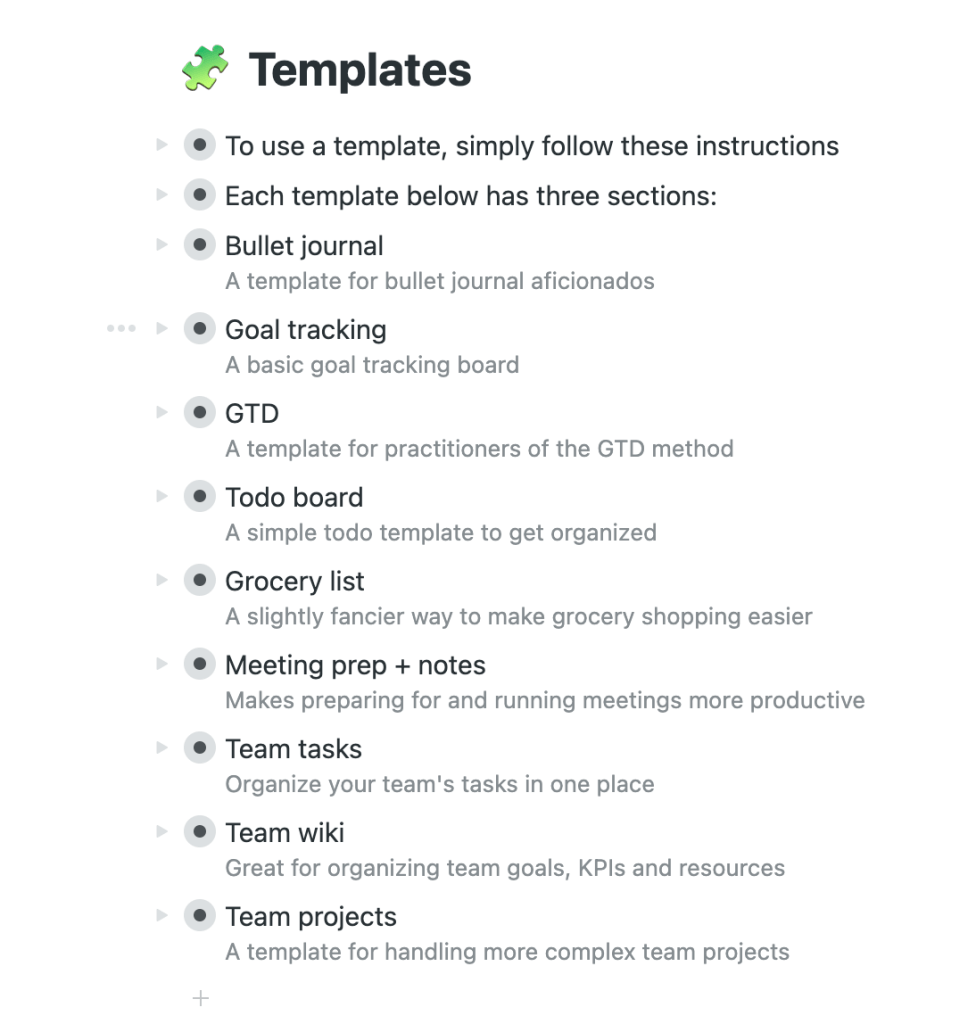
Now, this one is newer to me and I look forward to playing around with it a bit more. The cool part is that it has different templates that you can use depending on what type of list you are trying to create. It also has the option to organize it by boards or bullet points and you can go back and forth.


Google Keep

If you are an avid Google user, then Keep is for you. It integrates with your calendar and you can move it up on your waffle to keep it nice and close by when you open a new google browser tab. The neat thing about Google Keep is that you can add images to your lists and move them around. There is a lot more visual customization available than the other to-do list apps that are out there. You can add collaborators, set reminders, change the color, and copy to Google Docs. It’s definitely worth trying out!

Posted in Uncategorized

Ways to Create a To-Do List: Methods to Get Stuff Done Right Away!

You need to create a to-do list

Do you often make it through the day just putting out fires as they occur, trying to keep up? Creating and sticking to a schedule can help with managing time effectively. One helpful tool is to create a to-do list of action items that you need to get done. Over the years, I’ve tried different methods of writing a to-do list, which have worked for various purposes depending on my goals at the time.

A to-do list serves an important purpose in life. It keeps us from losing track of everything we have to do and helps focus our day on the things that really matter. It turns out that creating a to-do list can seem intimidating for some of us. But with a little bit of know-how, it becomes easier to create a to-do list. You won’t have to spend extra money and will be able to spend more time on the important stuff.

Why is it important to create a to-do list?

Making lists and prioritizing tasks helps you become more likely to accomplish your goals and reach your dreams. It also provides a way to track your progress and keep you motivated to move forward. To-do lists are great for both personal and professional use. You can use a paper and pen notebook to track it all or there are lots of great digital apps to organize tasks by category.

I’ll share some of the methods I’ve used to create to-do lists with you here.

create a to-do list
Photo by energepic.com on Pexels.com

THE EVERYTHING LIST

I like to call this list the everything list because it’s more or less a brain dump of all that has to be done. Sometimes I make columns for personal and work action items to keep them separate, but I just get it all down on paper (or digital). I’ve seen others refer to this method as the grocery list method because it’s just basically keeping a running tab of tasks as they pop into your brain.

Top Three to Five

For me, this method is helpful when I’m feeling overwhelmed. Instead of literally writing everything down that needs to get done, I write 3-5 MANAGEABLE items at a time. Then, when I’m able to cross them all off, I create a to-do list by writing 3-5 more items to accomplish. It’s comparable to time blocking a schedule. It’s focusing me to be intentional about what I want to accomplish within a certain timeframe.

Prioritized List

This method takes the everything method and then rearranges it based on your priorities. It’s easier to do this with a digital task management system because you can easily cut and paste the items and move them up and down on your list. One way to prioritize is to use the Eisenhower matrix. Some people even recommend a simple lettering system next to your tasks with A being the most important item to tackle first.

Big and Small

This type of to-do list breaks tasks into big and small tasks. You can think of them as time commitments. If it’s something like sending an email that will take 5 minutes to write, that could be considered a small task. If it’s completing an annual report, that might be a bigger task. Sometimes it’s more helpful to break up those big tasks into smaller ones and cross off those milestones as you reach them.

No matter how you organize your tasks and create a to-do list, the best thing to do is find what works for you. The physical act of crossing something off on paper to me feels so good that even though I manage my longer-term and ongoing tasks in a digital app, I still create a daily list of items that need to get done. I also try to keep it realistic so as not to get disappointed if I don’t get everything crossed off my list.

Happy to-do-ing!

Posted in Personal Skills, Time Management, Work From Home

Ways to Create a To-Do List: Methods to Get Stuff Done!

Do you often make it through the day just putting out fires as they occur, trying to keep up? Creating and sticking to a schedule can help with managing time effectively. One helpful tool is to create a to-do list of action items that you need to get done. Over the years, I’ve tried different methods of writing a to-do list, which have worked for various purposes depending on my goals at the time.

Why is it important to make to-do lists?

Making lists and prioritizing tasks helps you become more likely to accomplish your goals and reach your dreams. It also provides a way to track your progress and keep you motivated to move forward. To-do lists are great for both personal and professional use. You can use a paper and pen notebook to track it all or there are lots of great digital apps to organize tasks by category.

I’ll share some of the methods I’ve used to create to-do lists with you here.


THE EVERYTHING LIST

I like to call this list the everything list because it’s more or less a brain dump of all that has to be done. Sometimes I make columns for personal and work action items to keep them separate, but I just get it all down on paper (or digital). I’ve seen others refer to this method as the grocery list method because it’s just basically keeping a running tab of tasks as they pop into your brain.

Top Three to Five

For me, this method is helpful when I’m feeling overwhelmed. Instead of literally writing everything down that needs to get done, I write 3-5 MANAGEABLE items at a time. Then, when I’m able to cross them all off, I write 3-5 more items to accomplish. It’s comparable to time blocking a schedule. It’s focusing me to be intentional about what I want to accomplish within a certain timeframe.

Prioritized List

This method takes the everything method and then rearranges it based on your priorities. It’s easier to do this with a digital task management system because you can easily cut and paste the items and move them up and down on your list. One way to prioritize is to use the Eisenhower matrix. Some people even recommend a simple lettering system next to your tasks with A being the most important item to tackle first.

Big and Small

This type of a to-do list breaks task into big and small tasks. You can think of them in time commitment. If it’s something like sending an email that will take 5 minutes to write, that could be considered a small task. If it’s completing an annual report, that might be a bigger task. Sometimes it’s more helpful to break up those big tasks into smaller ones and cross of those milestones as you reach them.

No matter how you organize your tasks, the best thing to do is find what works for you. The physical act of crossing something off on paper to me feels so good that even though I manage my longer term and ongoing tasks in a digital app, I still create a daily list of items that need to get done. I also try to keep it realistic so as not to get disappointed if I don’t get everything crossed off my list.

Happy to-do-ing!

Posted in Uncategorized

My 4 Favorite Google Calendar Settings and Features

Google calendar settings can set you up for success!

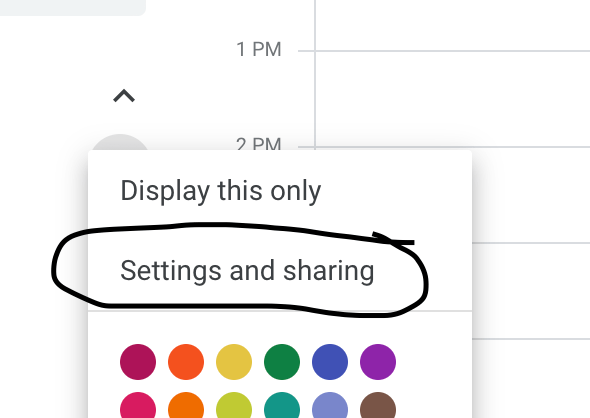
Settings and Sharing

google calendar settings

I use my Google Calendar for all of my professional and personal tasks. So, I share it with anyone who might need to get a hold of me or schedule something. However, I do not necessarily need them to see all of the event details, so I choose the option of just Free/Busy.

Notifications

Normally, I don’t like to have a lot of notifications coming through on my email, but I do have some calendar notifications set up. If something is changed or canceled, I do like the email to come through so I’m aware of it. That way, I don’t just happen to notice it missing from my calendar at a later time. Another helpful notification is to get a daily agenda from your calendar emailed to you. This helps as you think about planning your day each morning.

Color Coding Events

Originally, I utilized the create calendar feature to make a separate calendar for each of my activities. But then I realized if I was using the share calendar feature to alert people to my availability I would have to then share all of those calendars with them. So although it takes a second longer when I create an event … After I make it on my calendar, I right click the event and then change the color to match my coding for that activity. Then, at a glance, I can see what responsibilities I have for my freelance work, my teaching, and my school.

Multiple Time Zones

Another setting you can utilize on the calendar is to have more than one time zone displayed. This is helpful if you have to coordinate meetings with people who live in a different area. I have to do this and so I have two different time zones on my calendar to make it easier for me to plan meetings with others.

Overall, I find Google Calendar simple and user friendly. I like that I can access it on all my devices and put everything in one place!

Posted in Technology Tips, Work From Home

My Favorite Google Calendar Settings and Features

Settings and Sharing

Since I use my Google Calendar for all of my professional and personal tasks, I share it with anyone who might need to get a hold of me or schedule something. However, I do not necessarily need them to see all of the event details, so I choose the option of just Free/Busy.

Notifications

Normally, I don’t like to have a lot of notifications coming through on my email, but I do have some calendar notifications set up. If something is changed or canceled, I do like the email to come through so I’m aware of it and don’t just happen to notice it missing from my calendar at a later time. Another helpful notification is to get a daily agenda from your calendar emailed to you.

Color Coding Events

Originally, I utilized the create calendar feature to make a separate calendar for each of my activities. But then I realized if I was using the share calendar feature to alert people to my availability I would have to then share all of those calendars with them. So although it takes a second longer when I create an event. After I make it on my calendar, I right click the event and then change the color to match my coding for that activity. Then, at a glance, I can see what responsibilities I have for my freelance work, my teaching, and my school.

Multiple Time Zones

Another setting you can utilize on the calendar is to have more than one time zone displayed. This is helpful if you have to coordinate meetings with people who live in a different area. I have to do this and so I have two different time zones on my calendar to make it easier for me to plan meetings with others.

Overall, I find Google Calendar simple and user friendly. I like that I can access it on all my devices and put everything in one place!

Posted in Goal, Personal Skills, Time Management, Work From Home

Mastering the Power of Effective Scheduling: Some Tips to Make it Happen

Some people say that I’m a planner. Others say I’m calendar-oriented. Really, I just like to make sure that my time, tasks, and priorities are all reflected on my schedule. When someone asks me to do something and I agree (also power in saying no), I immediately add it to my Google Calendar, which can be accessed on my phone, iPad, and laptop. No matter where I am I have access to it.

If it is a work or professional meeting, I copy the Zoom or webinar link from the email and paste it directly into the calendar event that I create so that I do not have to search for the email when it’s time to log in.

Clarify your goals

It is important to know what you want to accomplish with your time. You cannot create an effective schedule if you don’t know what you are aiming for. I wrote a post on mini-goals here. Get specific on the main areas of your life and figure out the chunks of time that need to be spent on each.

Prioritize your tasks

When you sit down to work, or even at the beginning of every day, take a look at everything that needs to be accomplished. What is that one thing that can’t be put off? Do that first, in the morning if you can. For longer term projects, break it down into smaller deadlines and place those on your calendar. If you’re not sure how to prioritize, consider using a strategy like the Eisenhower Matrix.


Utilize a digital calendar like Google Calendar

Keep a calendar that can be accessed from all of your digital devices: laptop, phone, iPad, etc. That way, you always have access to what you need in the moment if someone asks to schedule something. Personally, because I work several part time jobs and manage my own schedule, I keep one Google Calendar for everything and color code by activity, including my personal commitments. For example, if a friend texts me and says, “hey, we should catch up on the phone Thursday around 8pm.” If I’m free, I actually confirm and add that to my calendar so I don’t forget to call or accidentally make plans to do something else because I forgot we were going to chat.

At work, I utilize my email kind of like a to do list. I try to check my email at certain points throughout the day, but if something comes on that I need to take care of that day or later in the week, I also add it to my calendar and include the reference email.

Learn to Say “Let Me Get Back to You”

If you’re a kind-hearted person who wants to follow through with helping people or do a good job, you’ll be tempted to say yes to everyone and everything. That is not a realistic way to manage a schedule because you will quickly become overwhelmed. However, instead of saying no right away, give yourself some think time when someone asks you to do something or for another meeting or a favor. Evaluate if it fits with your goals and priorities or fits in any extra time you have available for leisure. If not, perhaps you may have to decline or ask the person to check in with you at a later date.

These are just some of the strategies that I use on a regular basis to maintain my schedule. Please leave a comment if you’d like to hear more about any of them!

Posted in Uncategorized

Using the Eisenhower Matrix to Prioritize Your Important and Urgent Tasks

the Eisenhower Matrix

If you clicked on this article, you were drawn in by the prospect of prioritizing your tasks. Maybe you don’t know what the Eisenhower Matrix is, but you liked the Matrix movies and you kind of remembered that Eisenhower was a president or something. No worries – I am here to help you out with this strategy of prioritizing the tasks to be completed.

History of the Eisenhower Matrix

Other names for this matrix include the decision matrix or important/urgent matrix, but ultimately came from a quote by President Dwight Eisenhower.

I have two kinds of problems, the urgent and the important. The urgent are not important, and the important are never urgent.” – Dwight D. Eisenhower

https://woven.com/blog/the-eisenhower-matrix

From this quote, people took away the fact that there are four main categories that our tasks and activities fall into: urgent/important, urgent/not important, important/not urgent, and not important/not urgent. Although inspired by the quote from Eisenhower, the concept became popularized by Stephen Covey.

How Do We Use the Eisenhower Matrix?

Red pill or blue pill you say? Well, let’s take a look at something that could alter how you think about prioritizing your tasks. First, ask yourself if everything seems urgent and the world is constantly on fire. If you answered yes to that question, then utilizing this strategy could benefit your planning and reduce stress in your life.

When you have a new task pop up in your personal or professional life, before acting on it, take a moment to pause and decide which of the 4 quadrants below that it belongs in. If it truly is urgent, like your kid fell outside and hit their head, then of course handle it at the moment. If it’s a work email on a Saturday morning that doesn’t really have to be handled until Monday, well … can you pause and save it for Monday?

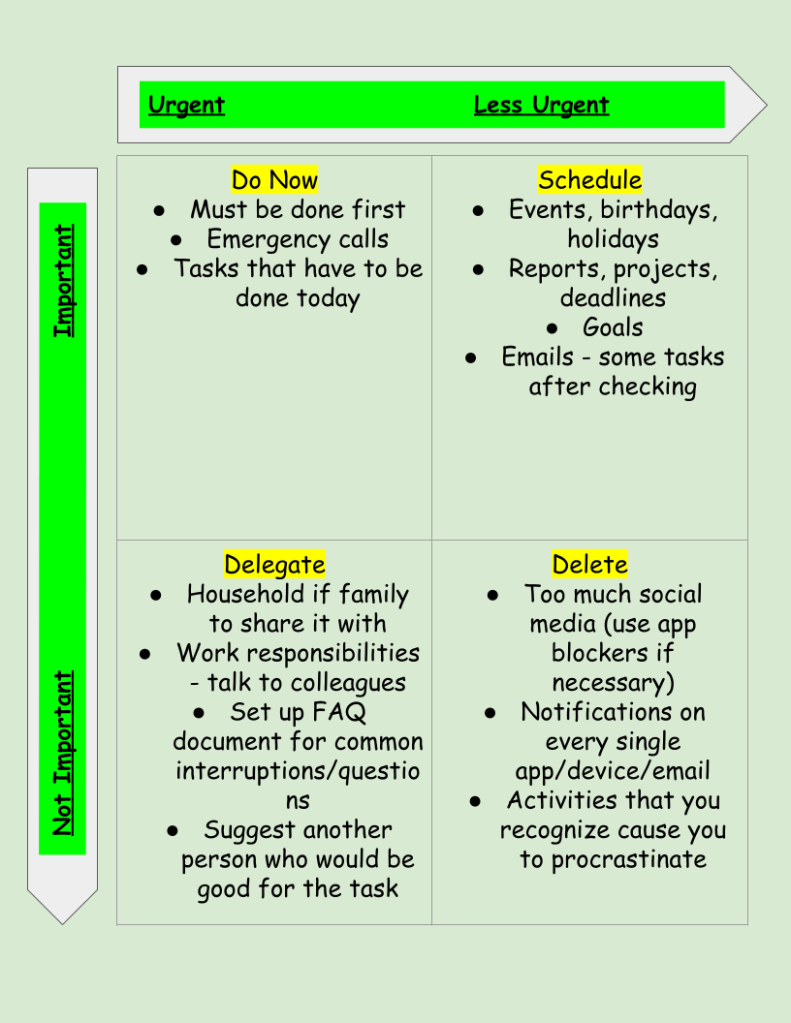
You can do this on a daily or weekly basis, but I find it to be helpful to periodically go through my big tasks and move them to different quadrants depending on what needs to be accomplished. Here is an example of a diagram you could create to visualize your task management:

eisenhower matrix

You’ll notice there is a box for the not important and not urgent tasks that says to delete. I prefer to look at this box as “in moderation” or evaluate shortcuts and strategies to become more efficient. Do I really need to get the CVS newsletter emailed to me every day? Probably not. In which case, I can delete it by unsubscribing and freeing up that inbox space and mental space. I wrote another post about email tips if you’re interested in checking that out.

So, next time someone asks you to do something or you feel that pressure that everything at work is urgent, decide if it is both urgent and important before you act. Check your 4 quadrants. If it is both urgent and important, go for it. If it’s not urgent, but still important, add it to your calendar for later in the day or in the week, but don’t forget about it. That’s why the matrix says to schedule it.


You can order these super cool daily sticky notes to keep yourself organized and prioritize each day:

Sources:

https://woven.com/blog/the-eisenhower-matrix

Product Plan Glossary

*Links to products are affiliate links

Posted in Time Management, Work From Home

Using the Eisenhower Matrix to Prioritize Your Tasks

If you clicked on this article, you were drawn in by the prospect of prioritizing your tasks. Maybe you don’t know what the Eisenhower Matrix is, but you liked the Matrix movies and you kind of remembered that Eisenhower was a president or something. No worries – I am here to help you out with this strategy of prioritizing the tasks to be completed.

History of the Eisenhower Matrix

Other names for this matrix include the decision matrix or important/urgent matrix, but ultimately came from a quote by President Dwight Eisenhower.

I have two kinds of problems, the urgent and the important. The urgent are not important, and the important are never urgent.” – Dwight D. Eisenhower

https://woven.com/blog/the-eisenhower-matrix

From this quote, people took away the fact that there are four main categories that our tasks and activities fall into: urgent/important, urgent/not important, important/not urgent, and not important/not urgent. Although inspired by the quote from Eisenhower, the concept became popularized by Stephen Covey.

How Do We Use the Matrix?

Red pill or blue pill you say? Well, let’s take a look at something that could alter how you think about prioritizing your tasks. First, ask yourself if everything seems urgent and the world is constantly on fire. If you answered yes to that question, then utilizing this strategy could benefit your planning and reduce stress in your life.

When you have a new task pop up in your personal or professional life, before acting on it, take a moment to pause and decide which box it belongs in. If it truly is urgent, like your kid fell outside and hit their head, then of course handle it in the moment. If it’s a work email on a Saturday morning that doesn’t really have to be handled until Monday, well … can you pause and save it for Monday?

You can do this on a daily or weekly basis, but I find it to be helpful to periodically go through my big tasks and move them to different boxes depending on what needs to be accomplished. Here is an example of a diagram you could create to visualize your task management:

You’ll notice there is a box for the not important and not urgent tasks that says to delete. I prefer to look at this box as “in moderation” or evaluate shortcuts and strategies to become more efficient. Do I really need to get the CVS newsletter emailed to me every day? Probably not. In which case, I can delete it by unsubscribing and freeing up that inbox space and mental space. I wrote another post about email tips if you’re interested in checking that out.

So, next time someone asks you to do something or you feel that pressure that everything at work is urgent, decide if it is both urgent and important before you act. If it is, go for it. If it’s not urgent, but still important, add it to your calendar for later in the day or in the week, but don’t forget about it. That’s why the matrix says to schedule it.


You can order these super cool daily sticky notes to keep yourself organized and prioritize each day:

Sources:

https://woven.com/blog/the-eisenhower-matrix

Product Plan Glossary

*Links to products are affiliate links