Posted in Goal

How to Be Productive After Time Off

How to be productive after time off is a big question. We all deserve our time to unplug, destress, and spend time with ourselves or our family. Whether that is to take a vacation or much-needed self-care time, it can be hard to get back into the swing of things.

I built a vacation into my arrival to Norway, with many months of preparation leading to this point. I felt guilty at first, but then I remembered how much time I put into getting my permit, online orientations, building out workshops, etc. So, if they said I should get my bearings before diving in, who was I to argue?

However, now that I know my way around the city a bit, I am ready to start my new job. Last Wednesday was my first day at the office picking up the iPad and phone that I will use as I travel.

I am finally somewhat adjusted to the time change, and tried my best to follow my previous morning routine with breakfast, affirmations, and planning time for the last several days.

how to be productive after time off

Now, it is Monday of a brand new week and I am going forward with getting back into “normal” work weeks. While I will occasionally have travel on the weekends, my hope is to prioritize working during the week. Then, rest on the weekends.

How to be productive: Here is what I am doing to get my productivity energy back:

  1. Get back on track with a morning routine, even if it’s just a few things. For example, today, I got up, stretched, made coffee, and wrote out my affirmations. Tomorrow, I will make my bed and spend some time in silence. I hope to add running back in to the mornings before work time.
  2. Create a healthy balance of work and personal time. I started emailing and to-do lists around 8:30am this morning. Now, I am about to break for lunch and go on a walk. I have to teach tonight from 6:30pm – 8:00pm so I don’t feel guilty about taking a long break in the middle of the day.
  3. Be forgiving with myself if I’m not on my “A” game right away. So, I did hit snooze this morning (a terrible habit I have been trying to break this whole year). I am disappointed that I reverted back, but I am not going to dwell on the mistakes of today when I can plan for success tomorrow.
  4. Re-start check-ins with my accountability partner. When I tell you that checking in weekly with someone is a game-changer, I mean it. For 2 years, I meet weekly with an accountability partner. We go over our weekly goals, our long term goals, time and scheduling challenges. Additionally, we provide much needed advice and encouragement.
  5. Sync Google calendar on all my devices. Because I picked up my new work technology, I need to sync everything so that all my calendars match up. I prefer using Google Calendar to track meetings and appointments. On my iPhone, I link my google account to the Apple calendar.

So, that is my recommended start to easing back into productivity. Most importantly, not trying to do everything all at once!

Posted in Goal

It’s a Productivity Puzzle! Fitting the Pieces Together

My productivity puzzle: Fitting the pieces of life together can be challenging at certain points. My productivity toward reaching my goals is something I have been proud of in the past. I put my mind to completing a half marathon and finishing a doctorate degree, among other goals along the way.

One goal I am excited about is now heading to Norway on a Fulbright to work with schools and continue my passion of civic education.

The last several months really put the idea of productivity into perspective for me. In fact, many times, I re-evaluated what it truly meant to be productive for me. I was so used to being busy, that it was nice to spend a little time reflecting on my hopes for this blog and getting to keep working on that goal.

productivity puzzle
Photo by Polina Zimmerman on Pexels.com

However, the time versus money internal debate came to a head when Norway was delayed yet again and I faced a huge lack of solid income. I had no choice but to take a temporary full time position that did turn out to be extremely stressful and left way less time for me to be productive toward these longer term goals.

These ebbs and flows of life are natural and it is up to us to make the most of our moments. Whether that means sitting down and trying to attain something greater for ourselves or simply taking a break to walk on the beach and get some fresh air.

Now, I face down this new opportunity to create a schedule around my commitments to my job and to myself. I think of this new journey as a productivity puzzle where I am trying to fit the pieces together. Truthfully, I am excited to arrive at my destination and spend some time working on my calendar and prioritizing my tasks.

As I continue to maintain a growth mindset, I will blog my learnings along the way and share helpful tips and advice that works for me!

Posted in Time Management, Work From Home

Using the Eisenhower Matrix to Prioritize Your Tasks

If you clicked on this article, you were drawn in by the prospect of prioritizing your tasks. Maybe you don’t know what the Eisenhower Matrix is, but you liked the Matrix movies and you kind of remembered that Eisenhower was a president or something. No worries – I am here to help you out with this strategy of prioritizing the tasks to be completed.

History of the Eisenhower Matrix

Other names for this matrix include the decision matrix or important/urgent matrix, but ultimately came from a quote by President Dwight Eisenhower.

I have two kinds of problems, the urgent and the important. The urgent are not important, and the important are never urgent.” – Dwight D. Eisenhower

https://woven.com/blog/the-eisenhower-matrix

From this quote, people took away the fact that there are four main categories that our tasks and activities fall into: urgent/important, urgent/not important, important/not urgent, and not important/not urgent. Although inspired by the quote from Eisenhower, the concept became popularized by Stephen Covey.

How Do We Use the Matrix?

Red pill or blue pill you say? Well, let’s take a look at something that could alter how you think about prioritizing your tasks. First, ask yourself if everything seems urgent and the world is constantly on fire. If you answered yes to that question, then utilizing this strategy could benefit your planning and reduce stress in your life.

When you have a new task pop up in your personal or professional life, before acting on it, take a moment to pause and decide which box it belongs in. If it truly is urgent, like your kid fell outside and hit their head, then of course handle it in the moment. If it’s a work email on a Saturday morning that doesn’t really have to be handled until Monday, well … can you pause and save it for Monday?

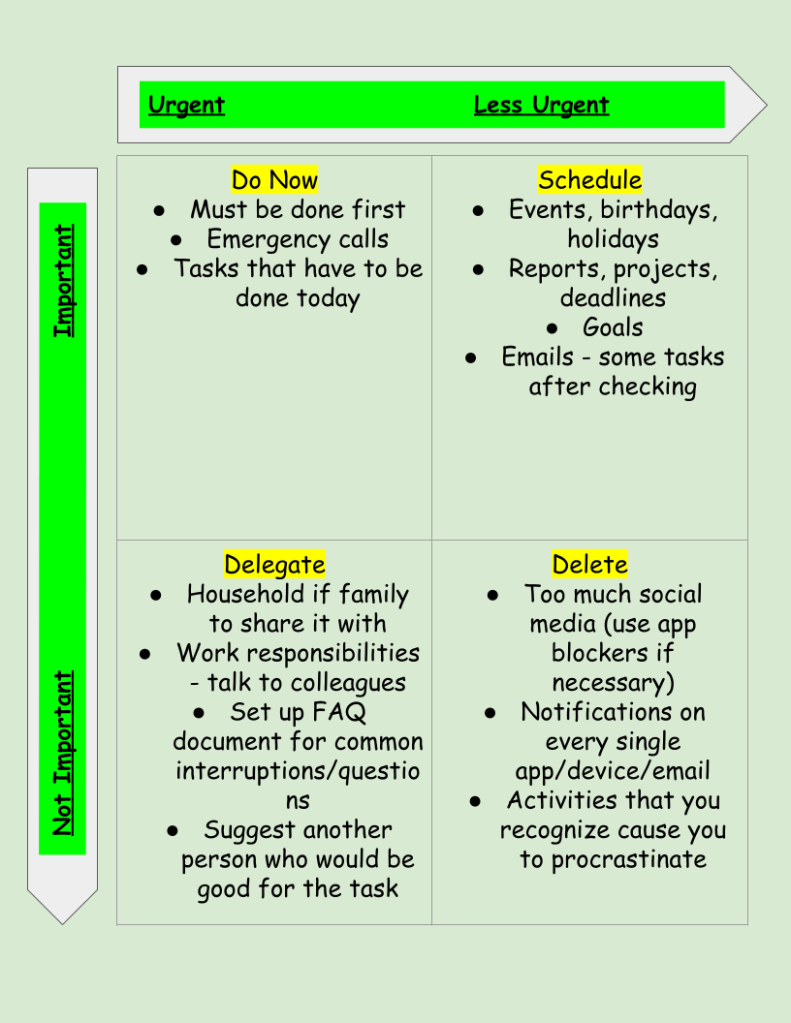
You can do this on a daily or weekly basis, but I find it to be helpful to periodically go through my big tasks and move them to different boxes depending on what needs to be accomplished. Here is an example of a diagram you could create to visualize your task management:

You’ll notice there is a box for the not important and not urgent tasks that says to delete. I prefer to look at this box as “in moderation” or evaluate shortcuts and strategies to become more efficient. Do I really need to get the CVS newsletter emailed to me every day? Probably not. In which case, I can delete it by unsubscribing and freeing up that inbox space and mental space. I wrote another post about email tips if you’re interested in checking that out.

So, next time someone asks you to do something or you feel that pressure that everything at work is urgent, decide if it is both urgent and important before you act. If it is, go for it. If it’s not urgent, but still important, add it to your calendar for later in the day or in the week, but don’t forget about it. That’s why the matrix says to schedule it.


You can order these super cool daily sticky notes to keep yourself organized and prioritize each day:

Sources:

https://woven.com/blog/the-eisenhower-matrix

Product Plan Glossary

*Links to products are affiliate links

Posted in Uncategorized

Using the Eisenhower Matrix to Prioritize Your Important and Urgent Tasks

the Eisenhower Matrix

If you clicked on this article, you were drawn in by the prospect of prioritizing your tasks. Maybe you don’t know what the Eisenhower Matrix is, but you liked the Matrix movies and you kind of remembered that Eisenhower was a president or something. No worries – I am here to help you out with this strategy of prioritizing the tasks to be completed.

History of the Eisenhower Matrix

Other names for this matrix include the decision matrix or important/urgent matrix, but ultimately came from a quote by President Dwight Eisenhower.

I have two kinds of problems, the urgent and the important. The urgent are not important, and the important are never urgent.” – Dwight D. Eisenhower

https://woven.com/blog/the-eisenhower-matrix

From this quote, people took away the fact that there are four main categories that our tasks and activities fall into: urgent/important, urgent/not important, important/not urgent, and not important/not urgent. Although inspired by the quote from Eisenhower, the concept became popularized by Stephen Covey.

How Do We Use the Eisenhower Matrix?

Red pill or blue pill you say? Well, let’s take a look at something that could alter how you think about prioritizing your tasks. First, ask yourself if everything seems urgent and the world is constantly on fire. If you answered yes to that question, then utilizing this strategy could benefit your planning and reduce stress in your life.

When you have a new task pop up in your personal or professional life, before acting on it, take a moment to pause and decide which of the 4 quadrants below that it belongs in. If it truly is urgent, like your kid fell outside and hit their head, then of course handle it at the moment. If it’s a work email on a Saturday morning that doesn’t really have to be handled until Monday, well … can you pause and save it for Monday?

You can do this on a daily or weekly basis, but I find it to be helpful to periodically go through my big tasks and move them to different quadrants depending on what needs to be accomplished. Here is an example of a diagram you could create to visualize your task management:

eisenhower matrix

You’ll notice there is a box for the not important and not urgent tasks that says to delete. I prefer to look at this box as “in moderation” or evaluate shortcuts and strategies to become more efficient. Do I really need to get the CVS newsletter emailed to me every day? Probably not. In which case, I can delete it by unsubscribing and freeing up that inbox space and mental space. I wrote another post about email tips if you’re interested in checking that out.

So, next time someone asks you to do something or you feel that pressure that everything at work is urgent, decide if it is both urgent and important before you act. Check your 4 quadrants. If it is both urgent and important, go for it. If it’s not urgent, but still important, add it to your calendar for later in the day or in the week, but don’t forget about it. That’s why the matrix says to schedule it.


You can order these super cool daily sticky notes to keep yourself organized and prioritize each day:

Sources:

https://woven.com/blog/the-eisenhower-matrix

Product Plan Glossary

*Links to products are affiliate links