

Posted in Mindset

2023: 5 Guidelines to Live By

Guest Post by Lauryn Woodman

Instructional Designer, Educator, Accessibility Advocate


The Inspiration

I watched this video a few days before the New Year. I recommend you watch it, too.

To summarize for those of you who aren’t link clickers, it’s basically Rob Dyrdek saying that he never wants to get to a “reactive” place in 2023, and explaining that doing so will require a high level of discipline. My podcast preferences tend to lean more towards True Crime than privileged men spouting “motivational” buzzwords, but this one spoke to me. Scrolling through the comments, I saw many who interpreted Rob’s message as needing to work harder, grind harder, and go bigger. What I got out of it was so different. And it’s shaped my goal for 2023:

The Goal

In 2023, I never want to get to that low, terrible, reactive place. 

The Guidelines

And to do so, will require discipline. Here are 5 guidelines I’ve set for how I plan to live my life in 2023.

5 in a vase
Photo by Nataliya Vaitkevich on Pexels.com
  1. In 2023, I will be respectful of my own boundaries. I will not stretch myself beyond my capacity to accommodate the desires of others. I’ll give myself the grace to say no and not feel guilty. I will indulge in rest when rest is needed. 
  2. In 2023, I will not allow others’ energy to influence my own. I tend to take on other people’s stress, their drama, and even their emotions. This year, I will hold space for my own energy, and no one else’s.
  3. In 2023, I will live freely. With no strings, no bonds, and without allowing outside forces to shape the direction of my life. I will go with the flow.
  4. In 2023, I will enjoy the journey. Whether I feel I am “on track” or not, I will know that each twist and turn in my life is leading me to exactly where I need to be, when I need to be there. 
  5. In 2023, I will enjoy the small moments, I will find joy in quiet moments with friends. See the value in the quiet nights in as much as the once-in-a-lifetime moments I will inevitably experience. I will live each day fully in the moment, no matter where the day takes me, realizing that each experience, no matter how mundane, is a gift.

selective focus photo of green plant seedling on tree trunk
Photo by David Alberto Carmona Coto on Pexels.com

I know that some of these guidelines might seem hokey or even unattainable. Or maybe to you, they sound obvious. But I know how I feel and how I act when I allow myself to get caught up in what I “think” I should be doing, or how I “think” I should be living. I know that I’ve allowed myself to get caught up in unnecessary drama from outside forces that has actually shaped the direction of my life and how I live. And I know that when I am that person, living that life, I am unhappy, unsettled, and unmotivated. I deserve a chance to live my best life, and I plan to do that in 2023.

I hope that all of you can find guidelines important to you and refocus your life in 2023 so that you can live the best life that you are capable of this year.

Posted in Time Management, Work From Home

Using the Eisenhower Matrix to Prioritize Your Tasks

If you clicked on this article, you were drawn in by the prospect of prioritizing your tasks. Maybe you don’t know what the Eisenhower Matrix is, but you liked the Matrix movies and you kind of remembered that Eisenhower was a president or something. No worries – I am here to help you out with this strategy of prioritizing the tasks to be completed.

History of the Eisenhower Matrix

Other names for this matrix include the decision matrix or important/urgent matrix, but ultimately came from a quote by President Dwight Eisenhower.

I have two kinds of problems, the urgent and the important. The urgent are not important, and the important are never urgent.” – Dwight D. Eisenhower

https://woven.com/blog/the-eisenhower-matrix

From this quote, people took away the fact that there are four main categories that our tasks and activities fall into: urgent/important, urgent/not important, important/not urgent, and not important/not urgent. Although inspired by the quote from Eisenhower, the concept became popularized by Stephen Covey.

How Do We Use the Matrix?

Red pill or blue pill you say? Well, let’s take a look at something that could alter how you think about prioritizing your tasks. First, ask yourself if everything seems urgent and the world is constantly on fire. If you answered yes to that question, then utilizing this strategy could benefit your planning and reduce stress in your life.

When you have a new task pop up in your personal or professional life, before acting on it, take a moment to pause and decide which box it belongs in. If it truly is urgent, like your kid fell outside and hit their head, then of course handle it in the moment. If it’s a work email on a Saturday morning that doesn’t really have to be handled until Monday, well … can you pause and save it for Monday?

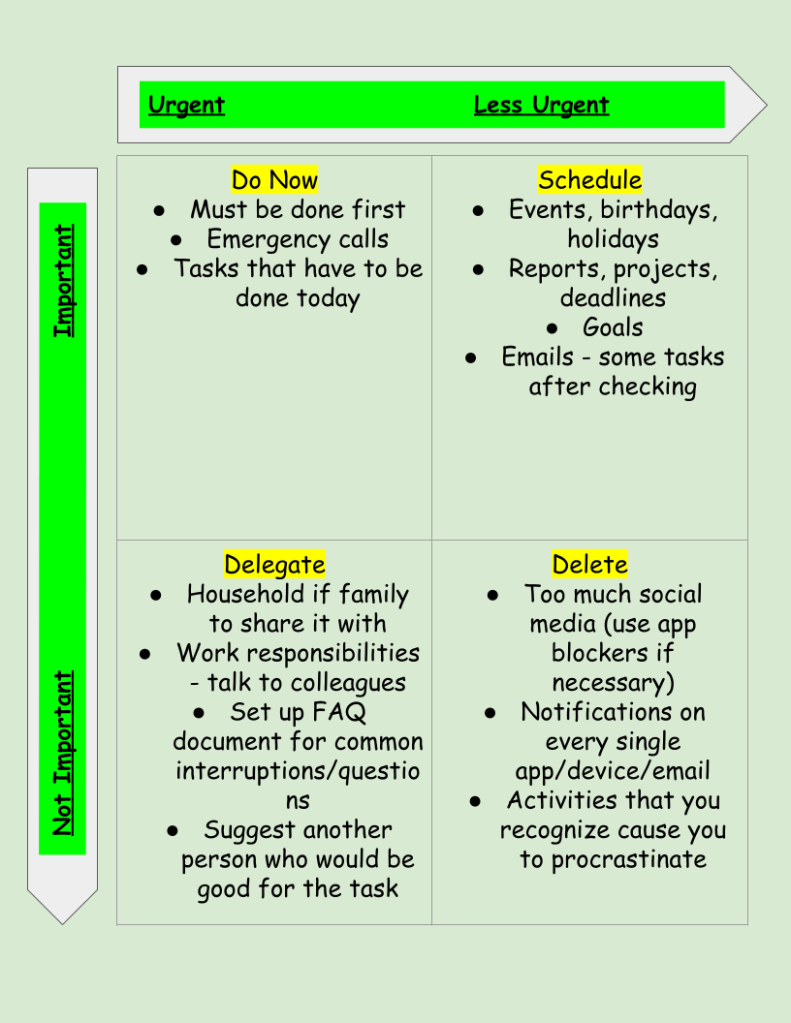
You can do this on a daily or weekly basis, but I find it to be helpful to periodically go through my big tasks and move them to different boxes depending on what needs to be accomplished. Here is an example of a diagram you could create to visualize your task management:

You’ll notice there is a box for the not important and not urgent tasks that says to delete. I prefer to look at this box as “in moderation” or evaluate shortcuts and strategies to become more efficient. Do I really need to get the CVS newsletter emailed to me every day? Probably not. In which case, I can delete it by unsubscribing and freeing up that inbox space and mental space. I wrote another post about email tips if you’re interested in checking that out.

So, next time someone asks you to do something or you feel that pressure that everything at work is urgent, decide if it is both urgent and important before you act. If it is, go for it. If it’s not urgent, but still important, add it to your calendar for later in the day or in the week, but don’t forget about it. That’s why the matrix says to schedule it.


You can order these super cool daily sticky notes to keep yourself organized and prioritize each day:

Sources:

https://woven.com/blog/the-eisenhower-matrix

Product Plan Glossary

*Links to products are affiliate links

Posted in Uncategorized

Using the Eisenhower Matrix to Prioritize Your Important and Urgent Tasks

the Eisenhower Matrix

If you clicked on this article, you were drawn in by the prospect of prioritizing your tasks. Maybe you don’t know what the Eisenhower Matrix is, but you liked the Matrix movies and you kind of remembered that Eisenhower was a president or something. No worries – I am here to help you out with this strategy of prioritizing the tasks to be completed.

History of the Eisenhower Matrix

Other names for this matrix include the decision matrix or important/urgent matrix, but ultimately came from a quote by President Dwight Eisenhower.

I have two kinds of problems, the urgent and the important. The urgent are not important, and the important are never urgent.” – Dwight D. Eisenhower

https://woven.com/blog/the-eisenhower-matrix

From this quote, people took away the fact that there are four main categories that our tasks and activities fall into: urgent/important, urgent/not important, important/not urgent, and not important/not urgent. Although inspired by the quote from Eisenhower, the concept became popularized by Stephen Covey.

How Do We Use the Eisenhower Matrix?

Red pill or blue pill you say? Well, let’s take a look at something that could alter how you think about prioritizing your tasks. First, ask yourself if everything seems urgent and the world is constantly on fire. If you answered yes to that question, then utilizing this strategy could benefit your planning and reduce stress in your life.

When you have a new task pop up in your personal or professional life, before acting on it, take a moment to pause and decide which of the 4 quadrants below that it belongs in. If it truly is urgent, like your kid fell outside and hit their head, then of course handle it at the moment. If it’s a work email on a Saturday morning that doesn’t really have to be handled until Monday, well … can you pause and save it for Monday?

You can do this on a daily or weekly basis, but I find it to be helpful to periodically go through my big tasks and move them to different quadrants depending on what needs to be accomplished. Here is an example of a diagram you could create to visualize your task management:

eisenhower matrix

You’ll notice there is a box for the not important and not urgent tasks that says to delete. I prefer to look at this box as “in moderation” or evaluate shortcuts and strategies to become more efficient. Do I really need to get the CVS newsletter emailed to me every day? Probably not. In which case, I can delete it by unsubscribing and freeing up that inbox space and mental space. I wrote another post about email tips if you’re interested in checking that out.

So, next time someone asks you to do something or you feel that pressure that everything at work is urgent, decide if it is both urgent and important before you act. Check your 4 quadrants. If it is both urgent and important, go for it. If it’s not urgent, but still important, add it to your calendar for later in the day or in the week, but don’t forget about it. That’s why the matrix says to schedule it.


You can order these super cool daily sticky notes to keep yourself organized and prioritize each day:

Sources:

https://woven.com/blog/the-eisenhower-matrix

Product Plan Glossary

*Links to products are affiliate links