
Posted in Uncategorized

Is Search Engine Optimization Worth It? (If You Ask Me, The Answer Is A BIG Yes)

Many people starting out new blogs or businesses ask, is search engine optimization worth it?

My opinion: Search engine optimization (SEO for short) is worth it. At the end of the day, you’re in business to make money or provide a service or information to people. And if your business or marketing model relies on free traffic, search engine optimization can propel you ahead of your competitors.

Let’s dig in!

Organic search traffic can make your business

Organic search traffic can make your business. What do I mean by that?

When you’re ranking high in Google for relevant keywords, you’ll get more traffic from people who are actively looking for what you offer. This means that they’re more likely to buy from you than if they found you through a display ad or social media post.

You can also use organic search to direct users to specific pages on your website where they can convert into newsletter sign-ups, landing page sign-ups, or even sales. For example, I get a lot of search hits for my Digital Freebies page on this website.

coffee apple iphone smartphone. is search engine optimization worth it?
Photo by Pixabay on Pexels.com

SEO is the gift that keeps on giving

If you do it right, your website will be visible at the top of search results for years to come. That’s why I’m so passionate about SEO. I truly didn’t take it seriously when I first started blogging and now I’m having to backtrack on old articles.

SEO isn’t an overnight success story. It takes time and effort, but in my experience, it gets easier over time as you learn more about your audience, keywords, and conversion rates.

Since installing RankMath Pro, it’s much more automated and simple process for me. For example, use all the tips and strategies to try to make it as close to 100 as possible for each post. After going back and doing this for 100 old blog posts, I almost QUADRUPLED my blog traffic in one month.
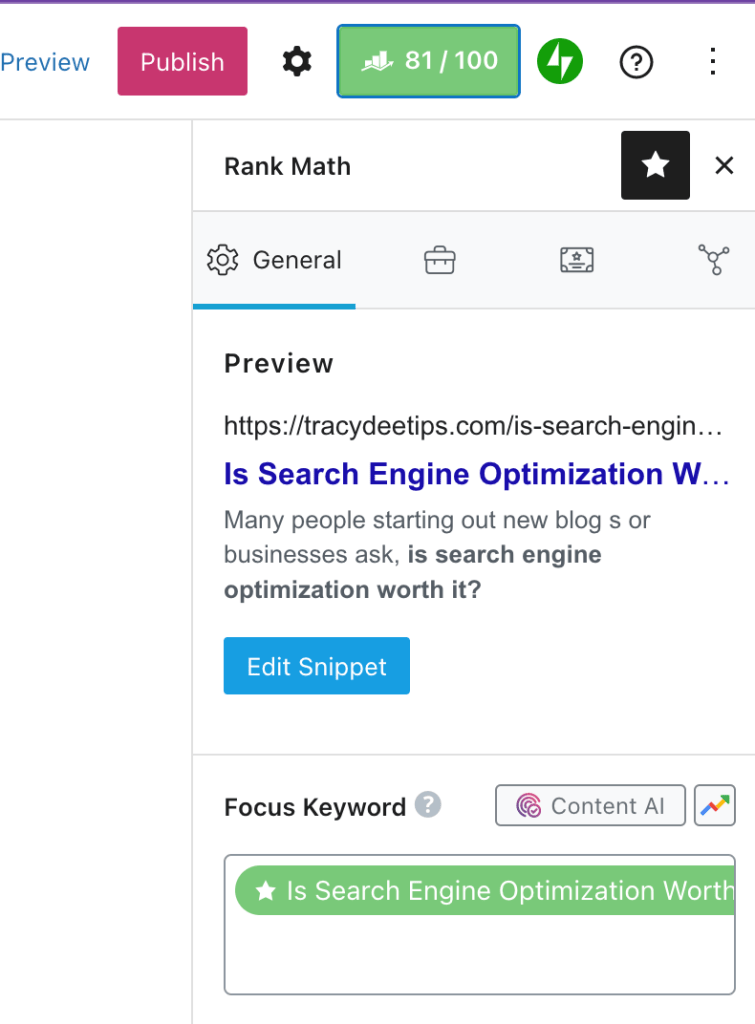
screenshot of using RankMath Pro. Is search engine optimization worth it?

So, again, is search engine optimization worth it?

If you want to see results and growth over time, then yes, SEO can be worth it if you have the patience and persistence to see through it all.

SEO is a long-term strategy

Here’s the thing though: SEO is a long-term strategy. It can take months to see results, and even longer to become an authority in your niche. And sometimes years if you’re truly building up a brand and name for yourself.

But with that being said, it’s important to understand the difference between short-term and long-term results when it comes to SEO. There’s no point in spending hours on Google looking for new ways to optimize your site if you don’t have any traffic or sales coming in.

The best way to approach SEO is by taking small steps each day and building up over time. You can’t expect everything to happen overnight—that is simply not how SEO works.

SEO is about improving the overall quality of your site so Google sees it as a resource that deserves to rank in its search results. If you want to rank on Google’s first page, you need content that people will find valuable. That means writing articles that are informative and interesting, with headlines that attract attention and explain what the article is about in a few words.

For example, the keywords I chose for this post are: “Is search engine optimization worth it?” How did I find this question and why did I choose it? I went to a website called Answer the Public and typed in search engine optimization. Basically, this website tracks user searches for different words and phrases.

person working on black laptop. Is search engine optimization worth it?
Photo by EVG Kowalievska on Pexels.com

So, if you clicked on this post, then likely you were searching for something similar to: “Is search engine optimization worth it?”

You also need backlinks from other sites pointing to your content. The more quality backlinks you have, the better your chances of ranking higher in Google’s rankings (and Bing’s).

If this sounds like it requires a lot of work, it does! But like any marketing strategy, it pays off over time as long as you stay committed to improving your site and writing great content for readers.

SEO is “free” marketing (sort of)

The good news: SEO is free!

The bad news: It’s not “free.” Sure, there are some things you can do to get started with SEO that doesn’t cost anything at all… but you won’t get very far if you don’t invest some time and money into your website. At the end of the day, time is money, so if you choose to do it yourself, then it’s going to take some time.

So, is search engine optimization worth it?

Search engine optimization is worth it because it can vibrantly grow your business if done well.

And that’s why I think Search Engine Optimization is worth the trouble. It’s a strategy that has the potential to return ten times the effort you put into it. If you’re already a marketer, SEO might be right up your alley—but if you’re newer to it all, don’t be intimidated.

Now that we’ve taken care of SEO 101, it shouldn’t be too hard to get started; plenty of guides out there can help you improve your search rankings. Either way, I hope this article has helped shed some light on the hustle behind SEO, and maybe even encouraged you to get started with it today!

Posted in Uncategorized

How to Optimize Your Blog for Search Engines in 7 Simple Steps

You’ve just started a blog and are wondering how to optimize your blog for search engines. You’re in luck because this post covers some of the most important strategies you can use to optimize your blog for search engines.

Optimize your blog for search engines using these simple steps

1. Keyword Research

Search engine optimization (SEO) is the process of making your website more visible and accessible to search engines like Google, Bing, and Yahoo. Search engine optimization techniques are ways to improve your website’s ranking in search results so that more people can find your site. Keyword research is a part of SEO and allows you to identify what people search for on Google, Yahoo, etc.

You can then use this information to help optimize your web pages to rank higher in searches. Keyword research is important because it gives you insight into what people are looking for and how you can make your content more relevant to their interests.

Keyword research starts with analyzing the keyword landscape that surrounds your industry. For example, if you are a blogger who writes about business and marketing topics, you would want to see what words and phrases other popular blogs in the same space use in their titles and URLs.

You would then want to see if it makes sense for your blog’s title or URL to be different from the norm or if it makes sense for you to include something that is commonly used by your competitors. Once you have completed this step, it is time to actually conduct some keyword research.

Searching for a good tool to do keyword research? Check out Google Ads keyword planner or Answer the Public.

2. Ask Readers for Feedback

One of the best ways to improve your blog is to ask readers for feedback. You can do this in a variety of ways. The most common method is to ask them directly at the end of each post. Simply write something like “Do you have any comments or questions?” and ask people to leave their thoughts in the comments section. (So yeah, go for it here!)

You should also consider setting up a form on your website where readers can contact you directly. This could be as simple as a contact page with an email address, or something more complex like a comprehensive contact form that lets users select different categories based on why they’re contacting you.

Consider creating a survey for readers to fill out as well. This is particularly useful if you want to know whether or not your blog is meeting people’s needs, or if there are certain topics that people would like to see covered.

document on top of stationery
Photo by Lukas on Pexels.com

3. Avoid Duplication

It’s important to avoid duplicate content, not only because you’re breaking search engine rules and could face sanctions from Google, but also because duplicate content isn’t as useful to your readers as unique content. However, if you are posting on different sites, make sure to note the original source in your settings. For example, I also post my content on Medium.

When you publish the same article on multiple pages of your site, you’re wasting the time of anyone who clicks through—they’ve already read this information on one of the other pages. If the articles are about the same topic, it can be even more confusing for your visitors to be bounced around, especially if they don’t see a clear distinction between what’s in one article and what’s in another.

I usually recommend that people write a single article containing all the relevant information they want to share, but with different subheadings or tags to indicate when they’re moving onto a new subtopic. It doesn’t matter if there are some overlaps in the writing from one section to another—that’ll happen naturally when you’re just writing about one thing anyway.

The important thing is that your reader has an easy way to tell when you’re talking about something new, so they don’t have to go back and reread an entire paragraph just because it wasn’t clear which part was a continuation of where they left off. This is helpful when trying to optimize your blog for search engines.

4. Use Internal Links

Internal links are hyperlinks that connect one page on your site to another page on the same site. Since search engine algorithms favor websites with more internal links, you will increase the value of your blog by strategically including links from all relevant pages to each other.

The quality of your content will also be improved if you include more links within the content itself because they will help guide readers through the rest of the article. For example, if you’re writing a post about how to develop your cooking skills, you could include a brief overview of common cooking methods at the beginning and end of the article, linking back to full articles on those methods elsewhere on your blog.

5. Edit Your Permalinks

The first step to optimize your blog for search engines is to check its permalink structure. This refers to the way the permalinks are set up on your site — how they look and how they affect search engine optimization.

Most blogs run on a WordPress platform, which is why we’ll focus on how to edit your permalink structure in WordPress.

By default, your permalink structure might look something like this: http://mywebsite.com/p=123. The p=123 part of the URL means that the page you’re looking at is the 123rd post on the site.

This doesn’t help you in search engine optimization because it doesn’t offer any information about what your post actually is about or what keywords might be contained within it.

Instead, you can have a permalink structure like this: http://mywebsite.com/how-to-build-a-trellis-for-your-garden/ which would help with search engine optimization, as it shows that all content contained in that article is related to building a trellis for your garden.

Make sure to update your permalink structure to take out the date! I didn’t do that at first and had to add a bunch of redirects to my old pages.

photo of man using laptop, optimize your blog for search engines
Photo by Canva Studio on Pexels.com

6. Update Your Old Posts

Whenever you have a new blog post, make sure you get it out there and promote it. But don’t forget about your old posts. Search engines are always crawling the internet for content. If Google finds a related blog to yours, it will bring that blog onto your results page. So it’s important to update to continue to optimize your blog for search engines.

It’s important that you update your old content to keep it relevant and current. By doing so, every time Google crawls through your website, it will find something new to add to the search results page. This is also how you can show potential readers that they can trust the content on your blog because it’s current and up-to-date.

When updating your old content, make sure you don’t change the URL or permalink of the post. If you do change anything, Google will classify it as a duplicate page instead of an updated version of the same page. In order to avoid this problem, select all of your old posts and check them individually to see what needs updating. When updating these posts, be sure to:

  • Add new links (other blogs and websites)
  • Add new images with alt tags (that contain keywords)
  • Do a double-check for any typos or grammatical errors

7. Optimize Your Images

One of the best ways to optimize your blog for search engine rankings is with optimized images. Search engines have a hard time reading the images themselves, but they do read the data surrounding it. Here are some things you should do for image optimization:

Use keywords in the filename of your images, such as “Atlanta-dog-trainer.jpg” instead of “IMG_01234.jpg”

Always fill out the alt tag when adding an image to your blog post. This is important for accessibility for blind people and for image searches by defaulting to the alt tag text if it cannot find anything else that matches the image search query.

Takeaway: SEO is a great way for you to increase traffic to your blog so take some time to learn the basics!