Hi my online content creator friends still doing the 9-5 grind!
90% of my work week at my full-time job is spent on my computer, staring at my screen and typing away. So when my work day ends, the last thing I want to do is stare at my screen even longer.
Build a completely digital income where I can live and work from anywhere.
Make that income reliant on me and my online business ventures rather than having to report to a boss or supervisor.
Challenges and solutions for online content creators
Challenge: Burnout — working on a computer is mentally tiring and can be tough on the eyes.
Solution: I’m trying to take more breaks to stretch. I’ve also decided it’s important to go back to the gym and participate in group dance workout classes. They motivate me and get my body moving! I am also doing a daily stretching challenge with my friend, and we check in with one another.
Challenge: Time — does there ever seem to be enough time in the day to get it all done? Balancing household needs, personal tasks, friends and family, work, and a side hustle can be a lot.
Solution: Get more on top of my calendar and try to follow the 5-second rule from Mel Robbins. Essentially, if I think about it too long, I’m just wasting time. Count to 5 and go for it. And I also started putting my phone away from me at night to stop the nightly scrolling on social media.
Challenge: Lack of inspiration or creativity — I have 155 drafts in my folder on Medium. So that’s not where the lack of inspiration is. It’s actually sitting down to write and finish a full article. Or making a Tik Tok video or YouTube video. Or posting a new digital product on my Etsy shop.
Solution: Choose a day and time to batch-create video content. I tried this out with Tik Tok last week and it worked great. I used ChatGPT to help me with short script ideas and filmed about 5 videos I released over a few days. However, I have so much existing content now that it’s time to repurpose and update. For example, I can post my Tik Tok’s to YouTube shorts. I can use RankMath to improve old blog posts for better SEO. I will use time blocking to work on digital products for the online stores.
I face other challenges as a full-time worker building an empire on the side, but these are the main ones I’m tackling now. Best of luck to you on your online content creation journey!
Are you on a journey to learn more investment tips? I’m on a path to financial freedom, and investing is a big part of the process.
Disclaimer: I am not a financial or investing expert. These are just my experiences, opinions, and learnings. I added the disclaimer because people have opinions and advice that might be different than mine based on experience and education. I just wanted to share 3 things that would have been helpful for me to know at the beginning of my investment journey.
Let’s go back in time to December 2020. That’s when I put my first $10 into the stocks. I didn’t know what I was doing, so I picked some random stocks and went for them.
A couple of months later, they were doing really well. I added more when I could, just $10 here and $10 there. By the time summer 2021 rolled around, the stocks were looking great!
Here is where I made my BIG mistake (well, maybe it won’t be a mistake in 10 or 20 years). I had some retirement savings sitting there, earning 0%. PLEASE check your IRA accounts and make sure you actually INVEST the money. So I filed the paperwork to move it and invested it all during the months of September/October 2021.
At that point, I was subscribing to Motley Fool and following the top stock pick advice. So, hopefully, in the long run, it will serve me well. But the problem was that I invested everything I had when the market was super high. After that, it started dropping and continued into 2022, dropping lower and lower and lower.
What CEO’s buy — You can check when CEOs buy stocks of their own companies. Some say this may indicate that the CEO thinks things will go well and the prices will rise. When they buy stocks, they are required to file a form. One website that tracks the purchases is here.
Dollar Cost Averaging — A year ago, I had never heard of this term before. Basically, this means you consistently put a little bit into the stocks for a long time. So over time, the average price you pay for the stock will balance out. This has helped me a lot since I bought a lot of stocks at top dollar. It also helps because I only invest small amounts in different stocks. I now have a diversified portfolio with daily ups and downs in different sectors. However, I think it has strong potential for the long term.
Dividend-paying stocks — One thing to consider when choosing which stocks to buy is the dividend yield. Not every stock pays a dividend, but some do and have consistent returns year after year. If you have a lot of money to invest, this is an easy way to make passive income. If you put all your investment money into dividend-paying stocks, you will get that money to re-invest. These are the stocks I am focusing on in 2023.
I hope these investment tips help you get started on your investing journey! I plan to share more as I educate myself and learn more on my own financial journey.
Being financially literate is very important and schools don’t do good enough job of preparing people to manage the various financial aspects of life. These are tips I wish I would have known years ago, but I’m glad to finally start now!
Have you been searching for how to connect with your audience in writing? Writing is a solitary pursuit. You sit in your room, pour your heart out onto the page, or type away in a coffee shop until your fingers are numb. But as a writer, it’s important to reach out to people and connect with them over what you’ve created. After all, if no one reads what you write, then why bother writing?
There are many ways for writers to connect with their audience, but it takes time and effort. The good news is that the more you put into building those relationships, the more rewards come back to you!
Develop your voice
Your voice is the unique way you communicate with your audience, and it’s a big part of what makes your work original. Your writing style should reflect who you are: your experiences and knowledge, as well as the way you speak. If you try to sound like someone else or copy their writing style, it will be difficult for readers to connect with you. They’ll see it as another impersonal article or blog post by an expert on a topic they don’t care about.
Developing your voice means developing a distinctive style of expressing yourself through writing. Whenever possible, use words that come naturally to you. If there’s something about how others speak that appeals to your writing style (e.g., “dude” instead of “man”), feel free to incorporate that into your sentences. But don’t worry about sounding like an expert (unless that’s your goal).
Don’t imitate how other writers present themselves professionally online through grammar rules or business vocabulary terms (which may not fit well anyway). Focus on speaking the way you would. Content and blog writing is more casual than writing an academic paper.
If you need to know where to start to connect with your audience, write about things you know. Are you knowledgeable about lawn maintenance or crafts?
You can even write about interests you have or things you are learning. I love to share new things I discover and how I’m using that in my life. For example, I just wrote this post on manifestation techniques for beginners because I’m incorporating these things into my life.
Do you feel frustrated or motivated by something? Write about it! These emotions come from your experience, and you can more easily speak to what’s happening.
Write about things that make your heart sing, and the work will flow from there! Your passion will come through in your writing, and you’ll be more likely to finish the piece.
Create a relationship with the audience and allow them to see you
You can connect with your audience by sharing your stories, experiences, struggles, successes, goals and plans. You do this by being relatable and honest—being yourself.
Sharing personal details about yourself allows the reader to put themselves in your shoes.
Why do you think people love memoirs? It’s because they can relate to the author’s story: “I went through something similar…” or “I could imagine myself in that situation….”
Include the audience in your process
How to connect with your audience in writing through the process? Including your audience in writing and publishing can help you connect with them. You can ask for feedback and advice, get to know your audience, find out what they want to read, and discover what they like about your writing or don’t like. Suppose something doesn’t click with them (such as a plot point or character). In that case, this will allow you to revise before publication without losing their trust and respect.
I need to do a better job of including my audience in my blogging process. I do an excellent job on my Medium platform but less on WordPress. I appreciate any comments you have if you are a regular reader here!
The more honest you are, the more likely readers will connect with you
Share your passion for writing with them, and let them know what inspires you to write and how your work has evolved. Dare to be vulnerable by sharing some of the challenges that have come up as a writer. These things won’t always be fun to talk about, but if it helps someone struggling with something similar, it’s worth it!
Here are some examples of ways I’ve been open in my writing:
I shared my anxiety in several posts and how I use meditation and self-care.
I include my goals and ambitions here and a transparent account of my successes and challenges.
As I learn new things, I share how I implement them.
I include more anecdotal life experiences on my Medium page.
In order to connect with your audience, you have to be willing to allow vulnerability to shine through your writing.
Final thoughts on ways to connect with your audience
Writing for your blog can be a lonely business. There are no editors to tell you when you’re wrong and no agents to help negotiate contracts or deals. The only people who can tell you what works and what doesn’t are the readers—but how do you get those readers in the first place? By connecting with them! Do this by developing your voice and creating a relationship with the audience so they feel they know who wrote this work and why they should care about it.
Have you ever thought about learning SEO based content writing?
Search Engine Optimization (SEO) is the process of improving traffic to a website from search engines via un-paid (“organic”) search results. SEO aims to get your website to rank higher in search engine results pages (SERPs). Search engines use automated ranking algorithms to index websites based on relevance and popularity. This formula is known as the “search engine algorithm”.
If you’ve ever thought about blogging or marketing, then it’s good to know some SEO based content writing tips. Trust me, I’ve been learning this as a I go and having to go back to old articles to make revisions. Now, I use RankMath to help me out!
I would have done much better if I had learned this from the beginning!
Conduct Keyword research
Keyword research is the process of finding out what people are searching for online so that you can write about those topics. The primary purpose of keyword research is to ensure that you’re targeting the right audience and using SEO based content writing that speaks to their needs.
Once you have your keywords (or key phrases), it’s time to consider how they should be incorporated into your article or blog post. You want to keep things natural, so readers don’t feel like they’re reading an infomercial!
To avoid keyword stuffing, try using synonyms instead of repeating the same phrase repeatedly in your copy. This will help ensure that each instance serves a purpose instead of just being included because “it sounds good”.
There are lots of free and paid resources. But I mainly use keyword plan from Google Ads and Answer the Public.
Use keywords in the title of your blog post (see my title!). This will help search engines find it and direct readers to the content they’re looking for.
Use a question in your title. This can help people click the link and make readers think about their answers.
Do keyword research first, then repeat that keyword in your article with a good ratio of keywords to total words for maximum effectiveness. For example, one of my keyword phrases in this article is SEO based content writing.
Write short paragraphs
Using short paragraphs is an excellent way to make your content more readable, making it more likely that people will read the entire post. It also helps with SEO based content writing since search engines can better understand what each paragraph is about and index them accordingly. Finally, short paragraphs help people share your content on social media. It makes it easy for them to click on the title of each paragraph and copy/paste it into their feeds.
Use Bullets and Numbering in the Blog post
Using bullets and numbering in blog posts can help make your post more readable, organized and scannable.
The readers will find it easy to read the blog post’s contents if they are listed in bullet points or numbers.
Bullets and numbering make your blog post more organized. This is important as it will help you organize the content better to look more attractive than before when they were not organized by using bullets or numbers.
Using bullets and numbers makes your content scannable for readers who may need more time to read long paragraphs. They may need bits of information from each paragraph. These items should be made easily accessible by using them as headings (in other words, put them near each other)and subheadings.
Use Proper Alt Attributes for Images
An alt attribute is the text alternative for an image. It describes what you see in the image and helps screen readers identify each image on your page. It is an important part of SEO based content writing.
For example, suppose you have a company logo as an image. In that case, you should include an alt attribute with the company name so that users who are visually impaired or use screen readers can read what it is. Or, if you have images of products in your blog post, write descriptive alt attributes for each. That way, search engine bots can also read and understand what they represent.
Write Meta Descriptions for Blog Posts
A meta description is a short description that shows up in search results. It plays a vital role in helping readers understand the content of a blog post and decide whether to click on it.
For this reason, meta descriptions should be unique, compelling and relevant to the post’s topic. They should be at most 160 characters to not overwhelm users with too much text in one place. A good rule of thumb is to write them so that they can help readers understand what your content is all about. This is helpful even without prior knowledge about your product or service offering.
The introduction is the most crucial part of your blog post and should be catchy, informative and short. The introduction should grab the attention of your reader so that they want to read further. It should also provide a brief overview of what you will discuss in your blog post.
The following are some valuable tips for writing a great introductory paragraph:
Begin with an engaging anecdote or question that makes readers want to know more about what you have to say (e.g., “Have you ever wondered why we love dogs?”)
Use numbers to illustrate facts or conclusions (e.g., “Did you know that there are more than 600 million dogs worldwide?”)
Ensure the sentence structure is straightforward by breaking long sentences into shorter ones. Or using subheadings when appropriate (e.g., “Let’s look at this issue one question at a time…”).
Keep your URL as short as possible
Keep your URL as short as possible. It would help if you also used hyphens to separate words and avoid underscores because they are not search engine-friendly.
It’s also essential to keep any descriptive words out of your URLs, as bots can use them when they crawl through websites’ backlinks (links pointing back at them). For example: If someone links back to your site using an anchor text like “Learn more about SEO, ” it will become clear what exactly you’re talking about if you have yourwebsite.com/learnSEO.
Link Internally with other blog posts on your blog
Linking internally on your blog is one of the best ways to increase the SEO value of your content and improve user experience. It’s also an excellent way to help create new content ideas and keep your writing fresh.
In addition, internal links are an essential aspect of search engine optimization (SEO). By linking to a blog post you’ve written, you can boost its ranking in Google. That will get more people to read it and increase its authority — or how much trust Google has in your site.
If there are other posts on your website that relate directly or indirectly to what you’re writing about now, link back! Anchor text doesn’t matter as much as having a relevant link within the article itself. However, if possible, use terms that pertain specifically to this section or topic rather than generic ones like “click here”.
Do keep the above points in mind for SEO based content writing for a website.
Remember to optimize your content. You can easily optimize your title, heading tags and content by following the guidelines above.
Remember to optimize your title. The title should be descriptive enough to attract readers. Also, try using keywords relevant to the topic of discussion for search engines like Google, Yahoo! Search and Bing crawl through it and rank better on SERPs (Search Engine Result Pages).
Remember to optimize your heading tags. Headings are significant in SEO because they help crawlers understand what your webpage is about, thereby helping them rank higher on SERPs. Titles of articles/pages should be preceded by H2-H6 headings according to their importance on the page’s structure, so search engines can see them and users can easily find them as they navigate through pages or blog posts related to the topic under discussion – SEO based content writing tips!
Imagine if you could double or even quadruple your blog’s traffic. You’re probably thinking, “That’s so much traffic! How do I do that?” The answer to that question is simple: RankMath.
Note: links going to the RankMath website are affiliate links. I only post affiliate links to services or products that I absolutely believe in because this is not an affiliate website.
If you’re serious about blogging or running a business site, then it’s likely that you want to boost your traffic. Good for you! It’s a smart step towards creating an online business empire. However, there are so many different ways to go about doing this that it can be difficult to know where should you begin. Well, look no further, because this article is going to walk you through my experience using RankMath.
RankMath is a WordPress plugin I’ve recently started using, which has helped me more than double my blog traffic. It shows you how to write long-tail/head keywords for any given keyword. In essence, it helps you make your website as SEO-friendly as possible. For instance, if I wanted to rank for the keyword “make money blogging,” this plugin would tell me exactly what phrases to use in my content and on other relevant pages. It also walks you through all the steps to make your post more Google-friendly.
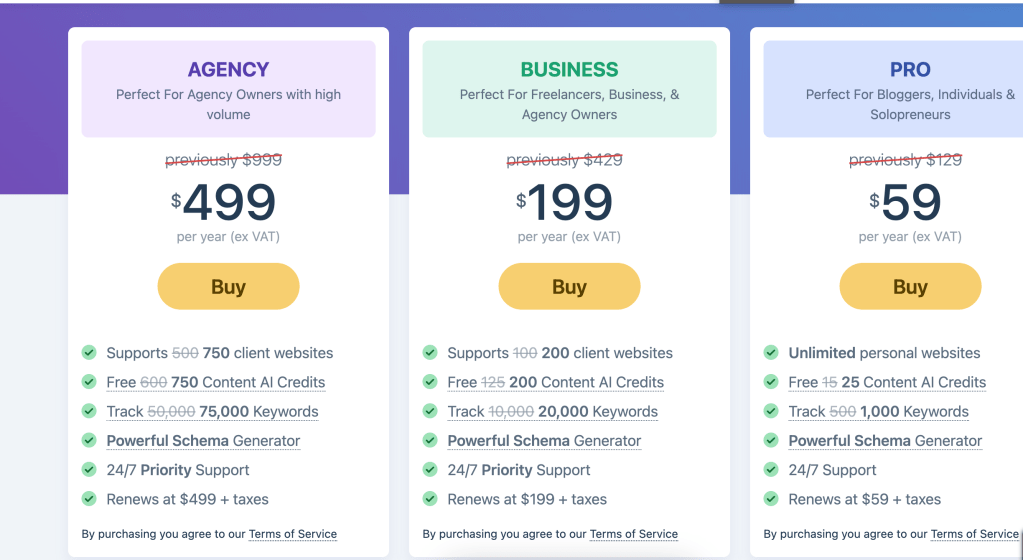
Over 1.5 million people use RankMath and I know why! It’s so user-friendly and has helped my blog traffic grow a lot even when I haven’t been posting as much. But is it free? Yes, there is a free version, but I didn’t think I could get everything I needed from the free version. So I upgraded to the PRO version, which is very affordable at only $129/year! And as you can see from the screenshot below, they are running a sale for the next 7 days (today is October 30th, 2022) for only $59. As my business grows, I will likely upgrade to the Business account.
What does it do for you?
RankMath provides webmasters and content writers with powerful tools for improving their search engine optimization (SEO). Since it was first released, it has become the leading SEO plugin on the market. If you look at the ratings, it is excellent at 4.9.
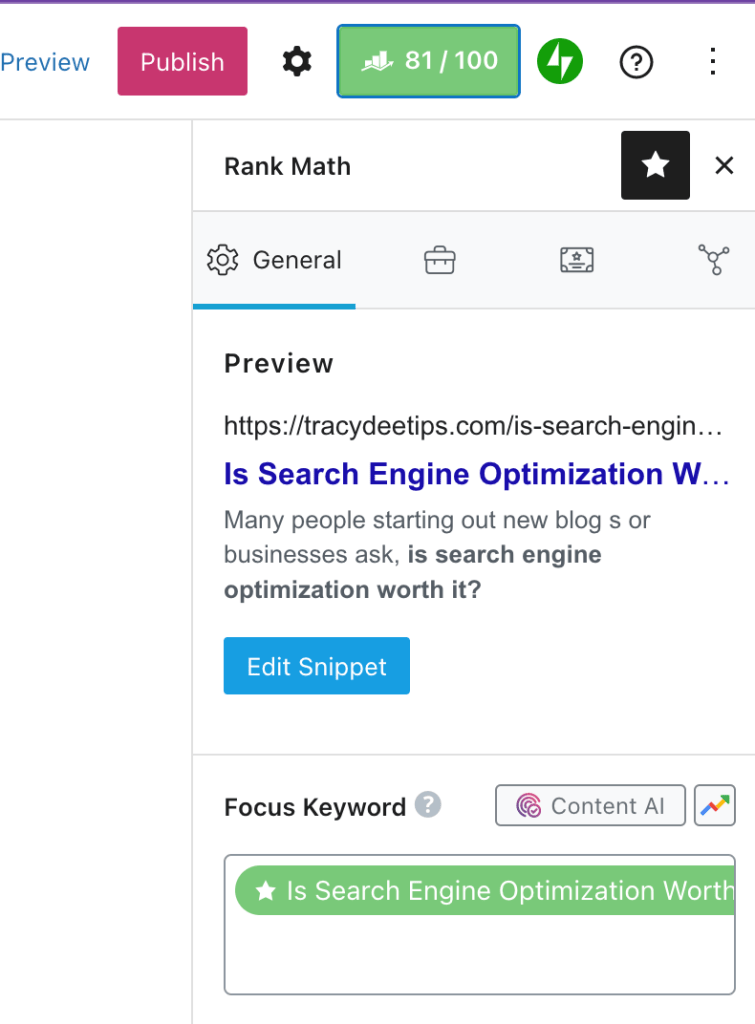
It offers an easy to follow guide that lets you customize and optimize your post for maximum searchability. It’s so user friendly and colorful and I enjoy watching everything change from red to yellow to green. You enter in your keyword, keyword phrase, or multiple keywords. Here you can see that the current post is optimized at 62/100. The goal is to get as close to 100 as possible.
Once you optimize over 80, then it turns green. As you can see, there are several steps I still have to take to get myself closer to green.
As I’m typing now, the content is getting longer and the keyword density is decreasing. The last thing I do on all my posts is create my links to other content on my blog or external links.
At the end, if I think I don’t have enough media, then I’ll add another image or two and definitely make sure to have one as my thumbnail.
Content AI is super cool because it allows you to see how your post ranks compared to others using the keyword. When I use this feature, I often see a jump in my posts score through RankMath.
Another great feature is to analyze the title. For example, my original title was How I More Than Doubled my Blog Traffic Since Using RankMath. I was able to see that my title didn’t contain any strong words and didn’t have my keyword (RankMath) at the beginning.
I also used RankMath to edit and optimize my 100 old blog posts that were currently on my site. Truthfully, I still haven’t optimized everything yet, so I think I would have even more growth if I did. Here is the full transparency that you can see through the easy to use analytics dashboard. Just imagine how much traffic I would have if I optimized everything to good!
Why I chose RankMath
Sometimes the best decisions are based on instinct. That was the case when I first encountered RankMath. I was feeling frustrated from an overall lack of growth in my site’s traffic, as well as some disappointment. I had tried using Monster Insights, but it wasn’t working so well for me.
I did some research and decided to give RankMath a try and I haven’t been disappointed. It seemed to be the easiest to use out of the different plug-ins available. And for someone who is still learning SEO, easy was what I was looking for.
Not to mention, any time I have had a question or problem, they are so quick to respond and solve the issue. They are constantly making updates to enhance user experience and make the tool even better.
My traffic since using RankMath
Since I started using RankMath in May 2022, you can see I’ve been able to consistently maintain views much higher than previous months. And if you compare that to my posting activity, that’s pretty good. I was not nearly as consistent in August – October, yet I still had higher views. Now, I feel more motivated than ever to add relevant content to continue to boost the traffic. After all, if this is a business, I have to treat it like one to see the fruits of my labor.
Changing my SEO strategy
I’m a fairly new blogger and only started my blog in February 2021 with relative inconsistency. The first couple of months I was struggling to get much traffic at all. I was trying to follow the normal blog marketing tips such as social networking and writing on a regular schedule. But it wasn’t really getting me anywhere until I started using RankMath.
Once I started focusing on keywords and using this tool to help me optimize my posts, I started to see growth! And it is something I want to continue. My goal is to bring all of my posts to a “green” level of optimization so they will start to rank more on Google search.
And I know a lot more now about keywords and keyword phrases so I can continue to make new content that is green from the start.
What I’ve learned from RankMath
If you’re a blogger and want to grow your traffic, I highly recommend you work with RankMath. Now I know so much more about keywords, URLs, links, titles, and so on to make my post as searchable as possible.
I still have more to learn, but I’m on a great path now to reach my ultimate goal of financial freedom!
Concluding thoughts
There is no one size fits all approach to SEO and if something doesn’t work for you, try switching it up. There are some best practices, but different ways of getting your information out into the Google universe.
Setting up your site using RankMath can boost traffic to your site and you can use a blogging calendar to boost traffic even more.
It is important to practice writing skills. I come from a strong academic background, but content writing for blogs is a whole new ballgame.
Because of that, I’m used to writing long academic research papers. However, that’s not the ideal style for a content writer to capture their audience.
Retraining your brain to be a content writer doesn’t happen overnight, but with practice and lots of motivation, you will eventually get better (I’ve been practicing for years and still have a long way to go).
These days, most writing jobs revolve around content. Whether we’re talking about blog writing, editorial writing or even social media posts. Content capturing a user’s attention is no easy task. Especially in noisy environments like Facebook and news sites where the average Internet user has already developed a practiced filter to ignore what they perceive as noise.
So, I’m retraining my brain to think like a content writer.
Here are five things I started doing and I encourage you to try them out:
Reading more blogs
Reading more blogs is one of the best ways to improve your writing skills.
There are many reasons for this, but the main one is that you get to see how other people write and communicate. You can learn from their mistakes, but also from their successes.
After a while, you’ll find that you’re not just reading blogs for the content; you’re also reading them for the writing style — and this is where things really get interesting. When you start noticing how someone else writes, it becomes much easier to spot good writing when you see it again in your own work.
It’s a bit like learning a new language: at first it’s hard work, but after a while things start to click into place and it all makes sense.
Practice writing in different styles, voices, and on different topics
Practice writing in different styles, voices, and on different topics.
Learning to write is a process of learning to write again and again. I can’t tell you how many times I had to rewrite drafts of my dissertation.
Writing is a skill that can be learned, practiced, and honed. When you write something, you’re not just creating something new — you’re also learning how to do it better next time.
That’s why it’s important to write as often as possible. The more you write, the more you’ll learn about your own style and preferences, which will help you become an even better writer.
You don’t need to be writing a novel or even an essay in order to get better at writing. Try writing down your thoughts on anything that comes to mind, whether it’s something personal or professional in nature. You can use any type of writing app (like Evernote) or grab some paper and a pen so that you can feel free to get creative with your style and voice.
The key is to practice as much as possible so that when it comes time for a big project, you’ll be ready!
Here are some prompts for deeper reflection to practice writing:
Write about a time when you felt like you were misunderstood.
Write about a time when you misunderstood someone else.
Write about something that happened in your life that changed everything forever.
Write about the last time you cried for longer than five minutes.
Write about the last time you laughed until it hurt your cheeks, stomach and ribs.
Write about a moment when you felt powerful or powerless.
Write about a moment when you felt insecure or self-assured.
Learn to embrace bullet points in blogs
Bullet points can help you improve your blog post readability, but only if they’re implemented correctly.
If you want to learn how to use bullet points successfully, read on!
Bullet points are an easy way to break up text into smaller chunks that are easier for readers to digest. This is especially useful in long blog posts where readers may get tired of reading large blocks of text.
There’s a lot of debate about whether or not bullet points should be used in blogs. Some people argue that they make the text look unprofessional and encourage skimming instead of reading carefully. Others say that bullet points make it easier for readers to find what they’re looking for within a longer post — especially when there’s a lot of information being presented in one place.
Bullet points are a great way to highlight key points in an article or blog post. They can be used to emphasize important ideas or make your writing easier to read.
If you want to improve your writing, then you need to stop trying to perfect everything and just get it out there. You need to practice writing as much as possible!
When I wrote research papers, I had to make sure everything was exactly right for my professors or for a conference presentation.
You see, perfectionism is a self-defeating attitude that doesn’t serve the purpose of producing good work. It’s not about producing good work — it’s about producing great work. And there’s no such thing as great work when you’re still in the editing process.
Perfectionism leads to procrastination, which means that you’re constantly trying to tweak that one perfect sentence or paragraph until it’s just right. But there will always be another perfect sentence or paragraph to tweak after that one! So every time you think about writing something new, suddenly your mind goes blank because all you can think about is how much better this other thing could be if only you had more time and energy to devote to it.
The solution is simple: Ditch the perfection and get something out there! Once your first draft is complete (which may not be perfect), then go back through and make changes as necessary.
Practice writing as much as you can!
Content writing is all about ideas, so it’s important to keep your mind as happy and free as possible. The best way to do this is by cultivating hobbies that make you happy. I recommend taking up new activities or seeking joy in the things you already enjoy doing. Inspiration comes in many forms!
Many people starting out new blogs or businesses ask, is search engine optimization worth it?
My opinion: Search engine optimization (SEO for short) is worth it. At the end of the day, you’re in business to make money or provide a service or information to people. And if your business or marketing model relies on free traffic, search engine optimization can propel you ahead of your competitors.
Let’s dig in!
Organic search traffic can make your business
Organic search traffic can make your business. What do I mean by that?
When you’re ranking high in Google for relevant keywords, you’ll get more traffic from people who are actively looking for what you offer. This means that they’re more likely to buy from you than if they found you through a display ad or social media post.
You can also use organic search to direct users to specific pages on your website where they can convert into newsletter sign-ups, landing page sign-ups, or even sales. For example, I get a lot of search hits for my Digital Freebies page on this website.
If you do it right, your website will be visible at the top of search results for years to come. That’s why I’m so passionate about SEO. I truly didn’t take it seriously when I first started blogging and now I’m having to backtrack on old articles.
SEO isn’t an overnight success story. It takes time and effort, but in my experience, it gets easier over time as you learn more about your audience, keywords, and conversion rates.
Since installing RankMath Pro, it’s much more automated and simple process for me. For example, use all the tips and strategies to try to make it as close to 100 as possible for each post. After going back and doing this for 100 old blog posts, I almost QUADRUPLED my blog traffic in one month.
So, again, is search engine optimization worth it?
If you want to see results and growth over time, then yes, SEO can be worth it if you have the patience and persistence to see through it all.
SEO is a long-term strategy
Here’s the thingthough: SEO is a long-term strategy. It can take months to see results, and even longer to become an authority in your niche. And sometimes years if you’re truly building up a brand and name for yourself.
But with that being said, it’s important to understand the difference between short-term and long-term results when it comes to SEO. There’s no point in spending hours on Google looking for new ways to optimize your site if you don’t have any traffic or sales coming in.
The best way to approach SEO is by taking small steps each day and building up over time. You can’t expect everything to happen overnight—that is simply not how SEO works.
SEO is about improving the overall quality of your site so Google sees it as a resource that deserves to rank in its search results. If you want to rank on Google’s first page, you need content that people will find valuable. That means writing articles that are informative and interesting, with headlines that attract attention and explain what the article is about in a few words.
For example, the keywords I chose for this post are: “Is search engine optimization worth it?” How did I find this question and why did I choose it? I went to a website called Answer the Public and typed in search engine optimization. Basically, this website tracks user searches for different words and phrases.
So, if you clicked on this post, then likely you were searching for something similar to: “Is search engine optimization worth it?”
You also need backlinks from other sites pointing to your content. The more quality backlinks you have, the better your chances of ranking higher in Google’s rankings (and Bing’s).
If this sounds like it requires a lot of work, it does! But like any marketing strategy, it pays off over time as long as you stay committed to improving your site and writing great content for readers.
SEO is “free” marketing (sort of)
The good news: SEO is free!
The bad news: It’s not “free.” Sure, there are some things you can do to get started with SEO that doesn’t cost anything at all… but you won’t get very far if you don’t invest some time and money into your website. At the end of the day, time is money, so if you choose to do it yourself, then it’s going to take some time.
So, is search engine optimization worth it?
Search engine optimization is worth it because it can vibrantly grow your business if done well.
And that’s why I think Search Engine Optimization is worth the trouble. It’s a strategy that has the potential to return ten times the effort you put into it. If you’re already a marketer, SEO might be right up your alley—but if you’re newer to it all, don’t be intimidated.
Now that we’ve taken care of SEO 101, it shouldn’t be too hard to get started; plenty of guides out there can help you improve your search rankings. Either way, I hope this article has helped shed some light on the hustle behind SEO, and maybe even encouraged you to get started with it today!
Signs of burnout may not be so obvious at first. You may have wondered … what does burnout feel like? What are the signs of burnout at work? Always tired? Stressed? Exhausted? If you’re experiencing several of these signs, then it’s possible that you might be experiencing burnout. If there’s someone you know that doesn’t look like they’re enjoying their work anymore – or perhaps it’s you – I’ve put together a list of 8 important signs of burnout to look out for. I’ve certainly been there myself and didn’t realize it until it was too late.
Disclaimer: This article is for informational purposes only. Please seek professional care and advice if you feel you need it.
You’re losing your sense of humor
For people who are high-functioning and have a positive outlook, burnout is often accompanied by a loss of humor. You might start feeling like everything is a drag, even the things that used to make you laugh. You find yourself rolling your eyes at people’s jokes, or just not laughing. This can be a sign that you’re getting burned out on life.
You’re avoiding people
It’s not always easy to tell when you’re burning out, but one of the biggest signs of burnout is that you start avoiding people.
You might find yourself pushing friends and family away or even just avoiding social situations altogether. You might feel like you don’t have anything in common with them anymore, or that they don’t understand what you’re going through.
But the truth is that when we’re burned out, it’s often because we feel so isolated—so alone—and it can be hard to know where to turn for support. That’s why it’s so important to reach out to someone who really cares about you and let them know how much their support means to you!
Indecisive
When you’re burnt out, you may find yourself struggling to make even the simplest decisions—you don’t feel like you have the energy or focus to make the choice, so you just put it off and hope something else comes up.
Decisions that once seemed easy and part of everyday life become chores.
When you’re in a state of burnout, it’s easy to lose sight of what’s important to you and what isn’t. You may start to let things slide that were once important—and even things that are important now but not as much as they used to be. It’s like the old saying: if you can’t do it well, then don’t do it at all.
It’s affecting your health
You may be feeling exhausted lately, and it’s not just due to lack of sleep. It seems like you’re simply going through the motions at work, and your home life is being affected as well. You’re finding it hard to eat healthy meals and exercise, which may feel more like an obligation than a desire.
These are all signs of burnout that should not be ignored. Additionally, you may be experiencing nagging health issues, such as a cough, headache, stomachache, or back pain that doesn’t seem to go away despite getting enough rest and nourishment. It’s important to take a step back and evaluate your lifestyle to make necessary changes before it’s too late.
When I was in the midst of burnout, my stomach always felt uncomfortable no matter what I did. It wasn’t until I stopped and took a number of things off my plate that I started to improve.
You’re experiencing mood swings
Mood swings can be an early warning of signs of burnout. If you’re experiencing mood swings, it might mean that you’re feeling more irritable than usual and are reacting more strongly to things that would normally be minor annoyances. Your mood swings could also be in response to the stress of work, which can happen when you’re not taking time to rest or care for yourself properly.
If this is happening to you, try to stay calm and keep your cool whenever possible. It’s also important to remind yourself that this is normal—it happens to everyone!
You feel helpless and hopeless
Experiencing burnout can make you feel like there’s no way out. However, it’s important to know that this feeling is quite common. Remember that these emotions are temporary and will eventually fade away. Don’t lose hope.
You don’t enjoy the things you used to
It’s common for changes to occur in our lives, which can manifest in various ways. Perhaps you used to enjoy socializing with friends but now prefer to stay home. Alternatively, you may have once been the life of the party but now shy away from the dance floor and avoid eye contact with others. Some of these evolutions are a normal part of growing and evolving, but some can represent a drastic change.
You may have also noticed a shift in your music preferences or a decrease in energy levels when it comes to exercise. When something feels off in your life, it’s crucial to reflect on why that might be happening and take steps to address it.
What can you do if you’re experiencing signs of burnout?
It’s important to take the time to address your emotional well-being, both as a worker and as a person in general. When you do that—when you slow down and devote yourself to self-care—you’re creating a space for the rest of your life to flourish. You’re taking steps towards a meaningful existence, and you won’t regret those decisions.
Note: AI tools were used in the process of creating this article, which is for informational purposes only.
Learning how to love yourself can be a difficult task. Most people are taught from a young age that self-love is selfish. Sometimes we just need a little help and direction on how to love ourselves as much as we love others.
I’m on this journey right there with you!
Accept the fact that you are your own person
You can’t be anyone else, and you can’t force yourself to change who you are. But that’s actually a good thing—it means that if you want to learn to love yourself, it’s going to have to come from inside of you, not from any external source. That’s why it’s so important for us to learn how to accept ourselves as we are and appreciate our strengths and weaknesses.
Talk positively to yourself
You may not think it, but you’re your own biggest critic. You’re always telling yourself that you aren’t good enough or that you need to improve, but the truth is that you are amazing just as you are. So next time a negative thought pops into your head, tell yourself instead how great you are!
Let go of the toxic people in your life and focus on being happy with just you, for you
There are millions of people in the world who are ready to love and accept you for exactly who you are, and there’s no reason to spend your time pining over someone else when there are so many more deserving people out there waiting for a chance to show you how much they care about you.
Take a compliment
When someone gives you a compliment, don’t brush it off or make excuses. Accept it, and be grateful for it! The more you accept compliments, the easier it will become to believe them yourself.
Stop comparing yourself to others
We all do it. It’s practically a human instinct. But it can be so damaging for your self-esteem and your relationships with other people when you’re always looking at them and wishing you were like them.
It’s important to remember that just because someone else is taller or shorter than you, or has a different hair color, or likes different music than you do, or thinks differently about things, that doesn’t make them better or worse than you! It just makes them different. And that’s okay!
They are a part of the world and they deserve love just as much as anyone else does. So next time you catch yourself feeling jealous of someone else, try reminding yourself of this fact instead: everyone deserves love; even if they’re not exactly like me!
Go Easy On Yourself
It’s hard to love yourself when you’re constantly beating yourself up, right? So work on being kinder to yourself. That doesn’t mean you don’t set high standards for yourself or that you reward yourself with something small like a piece of chocolate every time you do something good—it means that even when things go wrong, you can accept that as part of life and try again. And if something good happens, don’t let it go to your head—just appreciate it fully and then move on.
You are not the thoughts in your head
This is a very important fact to remember as you learn to love yourself. You are not the thoughts that run through your head, and you don’t have to be defined by them.
It’s easy to get caught up in the idea that we are our thoughts and feelings—especially if those thoughts and feelings have been negative for a long time. But it’s important to remember that these things can change, and soon enough, you’ll find yourself looking back on them with a laugh at how silly they seemed at the time!
Write down all the things you like about yourself
1. Start small.
Don’t try to write down every single thing you like about yourself. Just start with a few things that come to mind, and make sure they’re not just “I’m smart” or “I’m pretty.” Try to say something more specific, like “I’m good at making people laugh,” or “I’m really good at cooking.”
Start with the basics, but then add more details to make it feel more real: “My favorite color is blue, and I love how it looks on me!” or “I have a dog named Lucky who is always happy to see me.”
3. Remember what makes you special
When you find yourself feeling down on yourself, remember all of the things that make you special—they’ll help keep you going!
Remember – learning to love yourself might not happen overnight
Loving yourself is an ongoing process, one that takes time, patience, and strength; however, this is a worthwhile goal that everyone should strive for. Trust me, I’m a work in progress myself!
Organize your email inbox: A little over three years ago I made the switch to a zero inbox and it was the best thing I ever did for my organizational skills. At that time I had had my personal Gmail account since about 2005 with thousands and thousands of emails. Instead of taking time putting everything into folders, I simply decided to archive it all and start from that day forward. Since I started a new job, I was able to keep my work email at zero inbox from day one.
Table of Contents
Organize your email inbox: Here’s how I manage emails now to keep my inbox as close to zero as possible:
Check email first thing each morning (after affirmations and to-do list) and before I close my computer from work for the day. By doing this, I can deal with any emails that came in before I started my workday for all the early birds who start before me, and then I can create a plan for everything left over at the end of the day.
Check email at set times throughout the day. Now, I don’t always follow this rule perfectly because it depends on what I’m working on. If I need to focus on a project or task and I don’t want to be disturbed by emails, I close the tab and set my timer to check it once per hour or every 2 hours so as to still be responsive to the needs of coworkers, but not be interrupted by constant flows of incoming emails.
I use the two-minute rule when dealing with emails as I go through them. This idea comes from the Getting Things Done method by David Allen. If it’s something I can respond to right away, I quickly send a reply and then file that email in a folder. If it doesn’t need a response, I file it right away. If it’s informational and a deadline is attached, but it’s not immediate, I use the snooze feature to send it back to me when it needs to be completed or responded to. If it is going to take a bit longer, I work on it during an email response period during the day.
So by the end of the day everything should either be snoozed, responded to, or filed in a folder. I rarely delete emails because I do frequently have to refer back to old emails for information and it’s very easy to find when they are in folders. I also use the search function in Gmail to find the emails that I need. For newsletters and subscriptions, I create filters that send the emails directly to folders so it doesn’t even have to come to my inbox. These are great ways to organize your email inbox.
My personal favorite Gmail settings are to use the compact view with conversation view off. I like to see all my emails individually and conversation view confuses me a bit. Because I see all messages individually, I sometimes will only keep the most recent email in a thread and delete the rest because it’s not needed.
And, to save me a little time, I have smart reply turned on so it auto-detects what I might want to say. It’s kind of scary how accurate it is. I also use Grammarly to check my spelling, tone, and grammar as I go.
Organize your email inbox: Keeping my email organized and efficient has helped me to save time and communicate effectively!






















 Tracy Dee Tips